Format comparison
AVIF vs WebP: which next-gen image format should you use?
Both AVIF and WebP beat JPEG and PNG by a significant margin, but they differ on the compression versus speed tradeoff. AVIF compresses up to 50 percent better than JPEG; WebP lands around 25 to 35 percent better and encodes much faster. For a web page you control, AVIF is worth the encoding wait; for anything where speed of delivery matters more than every kilobyte, WebP is the practical choice.
What WebP does best
WebP was designed by Google as a drop-in improvement over JPEG and PNG for the web. It delivers roughly 25 to 35 percent smaller files than JPEG at the same visual quality, supports transparency and animation, and has been supported in every major browser since 2020. Encoding is fast: a batch of photos converts to WebP in seconds. That combination of solid compression, broad support and quick encoding makes WebP the safe default for images on a web page today.
What AVIF does best
AVIF is based on the AV1 video codec and achieves compression that is typically 50 percent better than JPEG and noticeably better than WebP at the same visual quality. It also handles smooth gradients and fine detail more cleanly than WebP, with fewer of the ringing artifacts that appear around high-contrast edges in lossy formats. Browser support has reached all major browsers since late 2023. The real cost is encoding time: AVIF takes minutes where WebP takes seconds, so it is best suited to images that are compressed once and served many times, such as hero images and product photos.
How to choose and test both in your browser
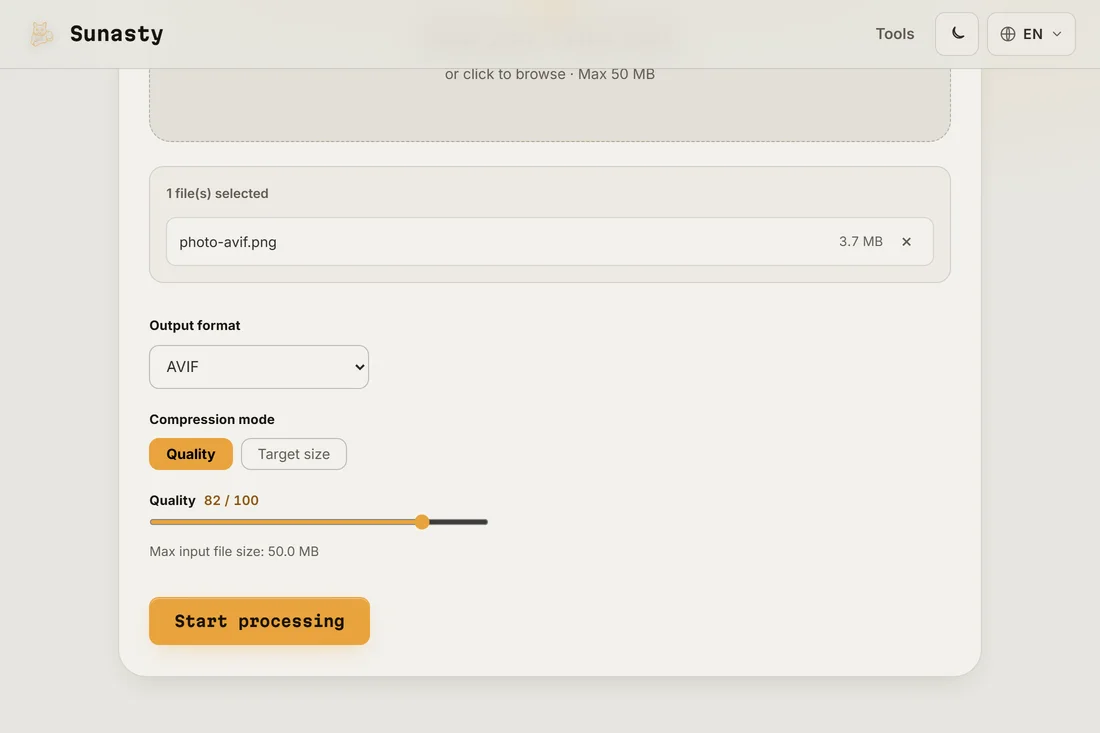
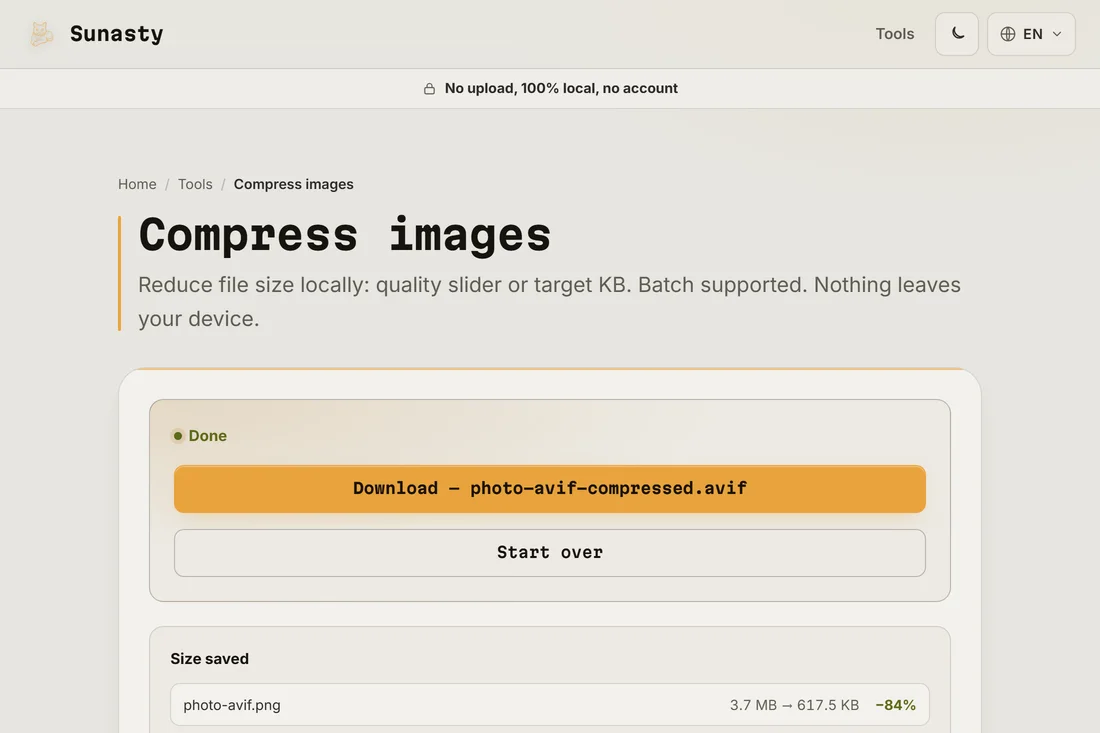
The practical approach is to try both on your own image and compare the results. Drop the same photo into the image compressor, export once as WebP and once as AVIF, and compare file size and visual quality side by side. The compressor runs entirely in your browser: your file never leaves your device. For a site hero image or a product gallery where every kilobyte affects page speed scores, AVIF is worth the extra encoding time. For user-uploaded content where you need to process many images quickly, WebP is the right tradeoff.
The tools used in this guide
- Compress images Reduce image file size without uploading. Quality slider or target file size in KB. Batch supported.
- Resize images Resize and convert your images (JPEG, PNG, WebP) without uploading them.
- Image to Base64 Convert images to Base64 data URIs (and back) directly in your browser. Copy, CSS snippet, no upload.
Frequently asked questions
Can I use AVIF without a WebP fallback?
For new web pages targeting modern browsers, yes. AVIF is supported in Chrome, Firefox, Safari and Edge as of late 2023, which covers the overwhelming majority of web traffic. If your audience includes older browsers or some mobile webviews you cannot verify, providing a WebP fallback in a picture element is the safe approach: browsers pick the first format they support and ignore the rest.
Which format should I use for transparent images?
Both support transparency. AVIF handles it with slightly better compression than WebP for the same quality. If the transparent image is a logo or UI element that appears on many pages, AVIF saves a meaningful number of bytes. If encoding speed is a constraint, WebP transparent is an excellent result and the practical choice for batch processing.