Article
Pokémon TCG tournament structure: rounds, top cut and resistance
Play! Pokémon runs its trading card game events as Swiss followed by a single-elimination top cut, with the cut size tied to attendance. This article explains the round format, how the cut scales, and the resistance-based tiebreakers that decide the bubble.
Best of three, 50 minutes
Pokémon TCG Swiss rounds are best of three games with a 50-minute timer plus a small number of end-of-time turns. A match win is worth 3 match points, a tie is worth 1 each, and a loss is worth 0. In best-of-three play, the player who lost the previous game chooses who goes first in the next one, rather than flipping for it again.
How many rounds
The round count grows with attendance in fixed brackets. Small events of 4 to 8 players run about 3 rounds; 9 to 32 players run 4 to 5 rounds; 33 to 64 run around 6; and larger events add more from there. The handbook publishes the exact table, and organizers follow it so the Swiss stage produces a fair seeding for the cut.
Top cut by attendance
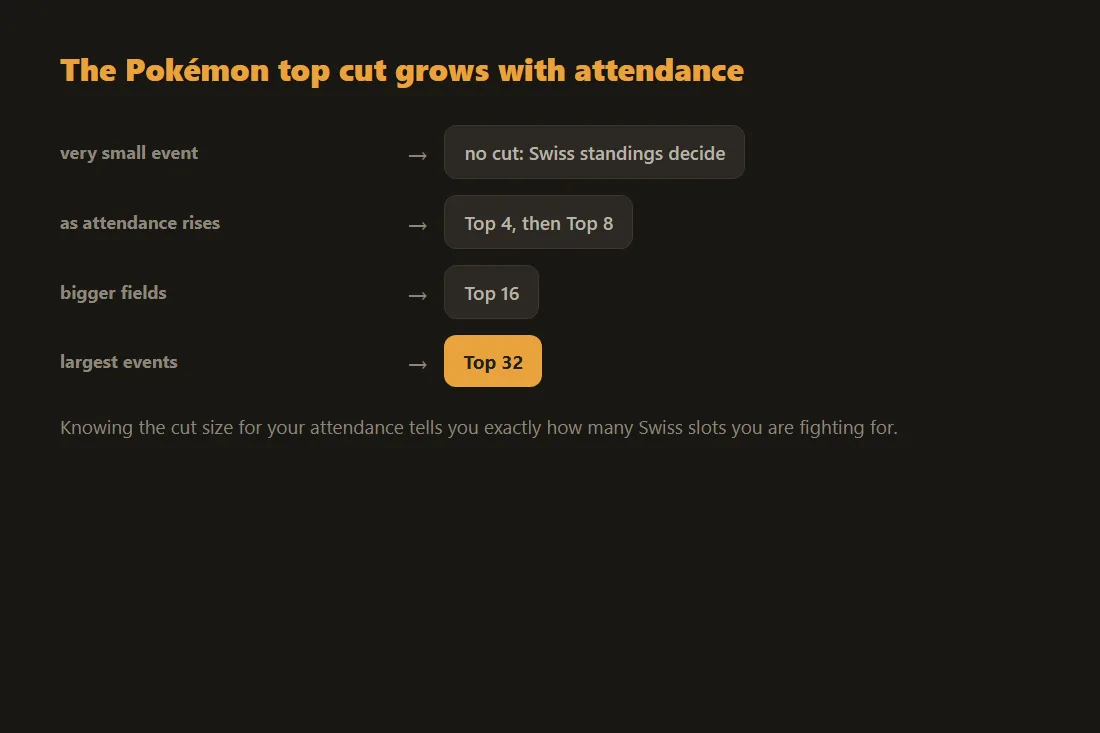
The size of the single-elimination top cut depends on how many players show up. A very small event may have no cut and award placings from the Swiss standings. As attendance rises, the cut grows through Top 4, Top 8, Top 16 and up to Top 32 at the largest events. Knowing the cut size for your attendance tells you exactly how many Swiss slots you are fighting for.
Tiebreakers: resistance
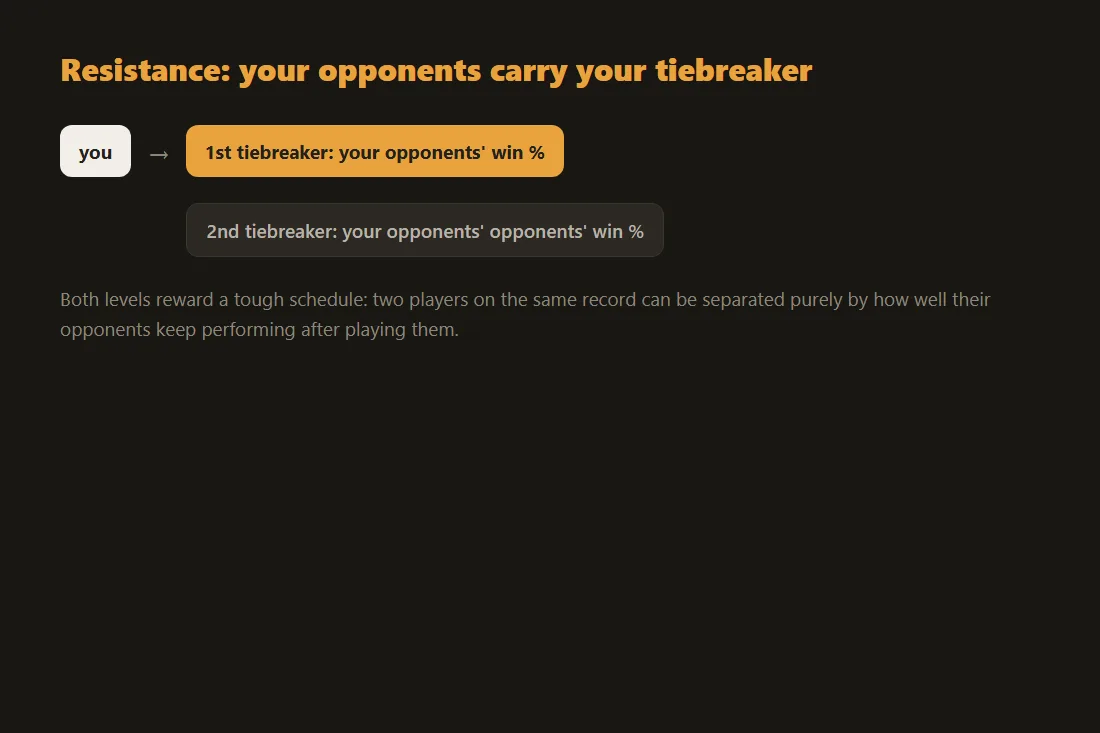
Pokémon breaks ties on what players call resistance. The first tiebreaker is your opponents' win percentage, the combined winning record of everyone you played. The second is your opponents' opponents' win percentage, one level deeper. Because both reward a tough schedule, two players on the same record can be separated purely by how well their opponents did in the rounds after they played them.
Reading the bubble
As with other games, two losses usually puts you on the top cut bubble at a typical event, where resistance decides who advances. One loss is usually safe and three is usually out, but the exact line moves with attendance and cut size. Since you cannot control your resistance, the honest way to plan is to estimate your odds from your remaining rounds and a realistic win rate.
Match points and Resistance in TOM
The Pokemon Trading Card Game uses Tournament Operations Manager (TOM) to run Swiss pairings at Regionals and International Championships. Match points follow a 3-1-0 scale: 3 for a win, 1 for a tie, 0 for a loss. When players share the same total, TOM applies Resistance as the first tiebreaker. Resistance in TOM is equivalent to Opponents' Match Win Percentage in other systems: the average win rate of every opponent you faced. Pokemon enforces a 0.25 floor, meaning any opponent who drops with a 0-4 record is calculated at 25 percent rather than zero. The second tiebreaker is Opponents' Opponents' Resistance, the average Resistance of those same opponents. Pokemon does not use Game Win Percentage, so the margin of a win (2-0 versus 2-1) carries no weight in the standings.
Asymmetric top cuts and Day 2 structure
At large Pokemon Regional Championships, the advancement threshold to Day 2 is not a fixed bracket size such as Top 32 or Top 64. Instead, all players who reach a specific match point total, usually corresponding to a 6-2-1 or X-2 record, advance. The exact record required can shift depending on total attendance and how the standings fall, so the Day 2 field varies in size from event to event. Once in Day 2, players complete additional Swiss rounds before a final cut to a Top 8 bracket. This structure means that dropping to three losses on Day 1 ends a player's tournament regardless of tiebreakers, since the point threshold becomes unreachable.
Championship Points and the Kicker system
Players compete at Pokemon events to accumulate Championship Points (CP) toward qualification for the World Championships. The number of CP distributed at a Regional, and how far down the standings they are paid out, scales with attendance through a Kicker system. A Regional below a certain attendance threshold pays CP down to a given finishing position; once attendance crosses a higher threshold, the Kicker activates and CP is paid to a larger portion of the field. In practical terms, a strong finish at a well-attended event can yield meaningful CP even for players outside the Top 8, while the same finishing position at a smaller event may yield none. Tracking the Kicker thresholds is a common part of competitive circuit planning.
This is an independent reference article. It is not affiliated with, endorsed by, or sponsored by any game publisher. All game names and trademarks belong to their respective owners. Always confirm the current rules with the official tournament policy for your event.
Frequently asked questions
How long is a Pokémon TCG round?
Swiss rounds are best of three games with a 50-minute timer, followed by a fixed number of end-of-time turns to finish the current game. The loser of each game chooses who goes first in the next.
What size is the top cut?
It depends on attendance. Cuts range from no cut at very small events up through Top 4, Top 8, Top 16 and Top 32 at the largest ones. The handbook lists the thresholds for each cut size.
What is resistance in Pokémon?
Resistance is the tiebreaker based on your opponents' records. The primary value is opponents' win percentage, and the secondary is opponents' opponents' win percentage. Higher resistance means you faced a tougher schedule, which ranks you above tied players who did not.
Can I control my tiebreakers?
Not directly. Your resistance depends on how the opponents you already played perform in later rounds, which is out of your hands. The only thing you control is winning your own matches, so aim to avoid the bubble entirely.