Article
Yu-Gi-Oh! tournament structure: Regionals, YCS and the v2.5 rules
Yu-Gi-Oh! changed its tournament policy meaningfully in September 2025. This article covers how the two events most players attend actually work today: the Regional qualifier, which has no top cut and hands out invitations by attendance, and the Yu-Gi-Oh! Championship Series (YCS), which runs a Top 8.
The format: best of three, no draws
Yu-Gi-Oh! matches are best of three games with a 50-minute round timer. The biggest change in Tournament Policy v2.5, effective 5 September 2025, is that there are no more draws. If a match has no winner when time is called and the end-of-match procedure runs out, both players take a loss rather than splitting the points. That makes every round decisive and removes the option of an intentional draw to coast into the cut.
Regional qualifiers: no top cut
A Regional qualifier is a Swiss-only event. There is no single-elimination playoff at the end; final placings come straight from the Swiss standings. Instead of a bracket, the event hands out invitations to the next stage based on how many people attended. The more players in the room, the more invitations are awarded, so the value of a Regional scales with its size.
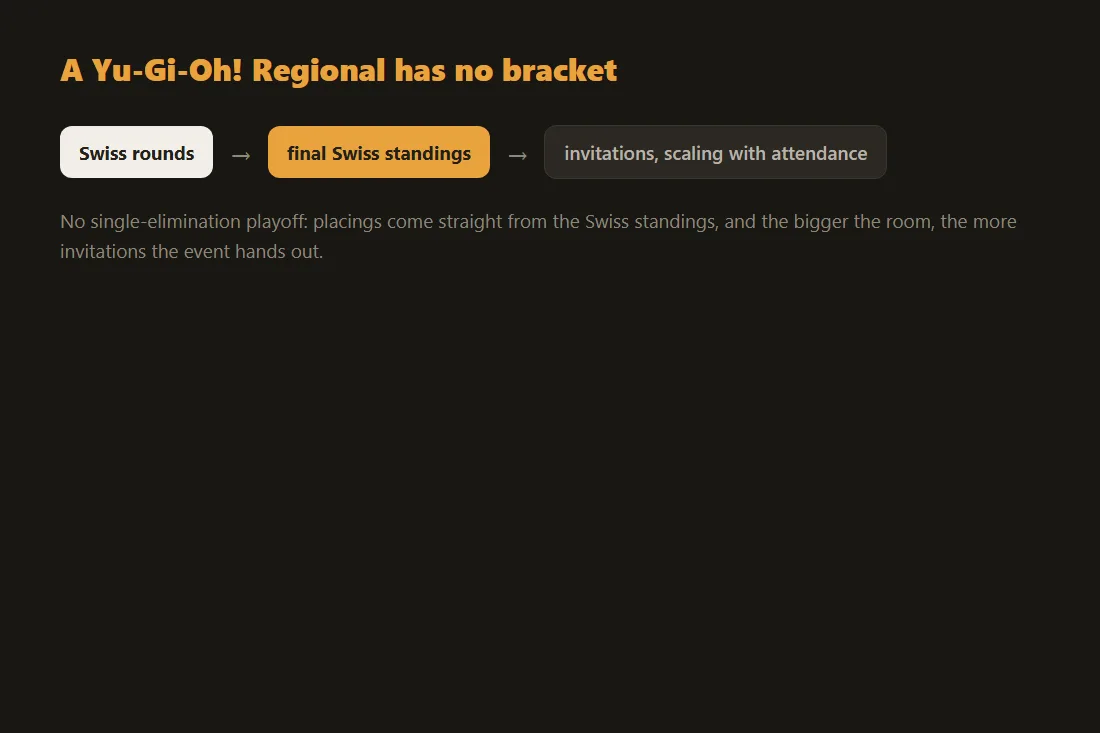
How invitations scale with attendance
The number of invites depends on the territory. In Europe the common rule is one invitation per eight players, rounded up. In the Americas a stepped table is used: a small event grants a handful of invites, and the count climbs through fixed brackets as attendance grows past 50, 100, 150, 200, 300 and 500 players. Because invites come from your final rank rather than a bracket, the practical goal at a Regional is to finish high enough in the standings to land inside the invitation cutoff.
Why a bye is the best possible result
Yu-Gi-Oh! tiebreakers run on match win percentage, then opponents' match win percentage, then opponents' opponents' match win percentage. A bye is excluded from your opponents' win percentage calculation. That is what makes it the best outcome: a real win gives you the points but also weakens the record of the opponent you beat, which can quietly lower your tiebreakers, whereas a bye gives you the points with no opponent attached at all. So a bye is strictly better than winning a match on the table.
YCS and the Top 8 cap
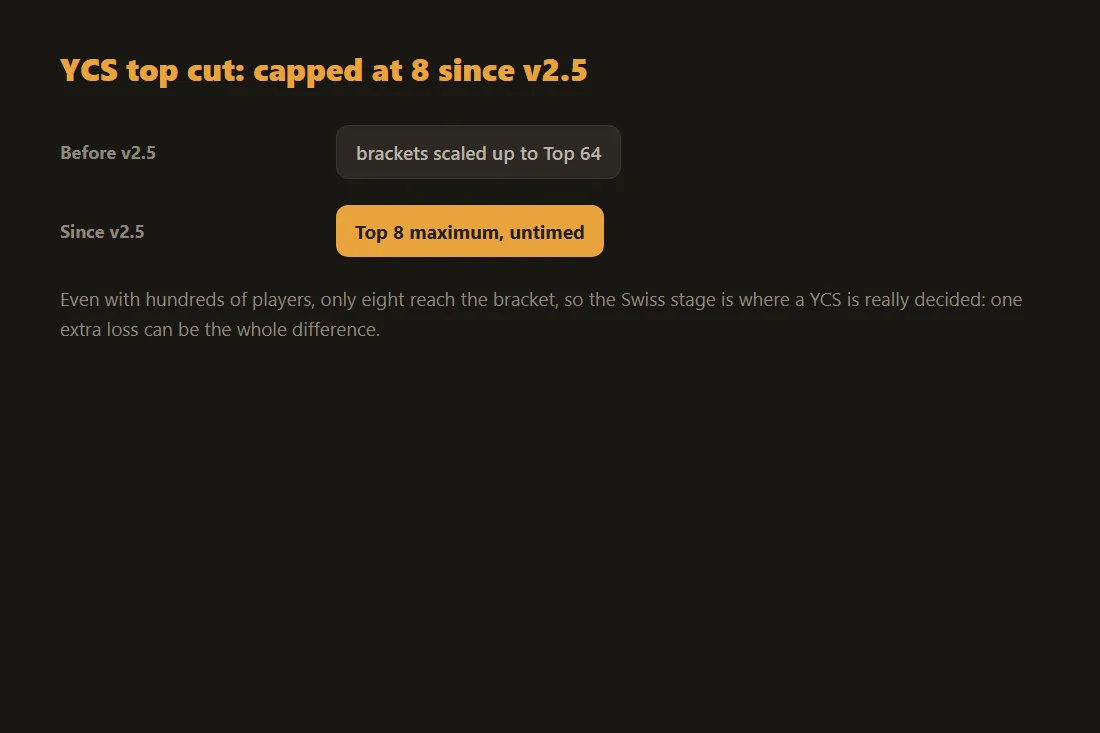
The Yu-Gi-Oh! Championship Series is the premier open event. It runs many Swiss rounds and then a top cut, which v2.5 capped at a maximum of 8 players, down from brackets that previously scaled up to 64. The top cut is also no longer timed. Because the cut is only Top 8 even at events with hundreds of players, the Swiss stage at a YCS is demanding, and a single extra loss can be the difference between the bracket and a high Swiss placing.
Double losses and the removal of intentional draws
The v2.5 update to the Yu-Gi-Oh! Tournament Policy, introduced in September 2025, removed intentional draws from high-level events such as Regionals and YCS tournaments. Previously, two players on the bubble could agree to a draw and each collect one point, which was often enough to secure a top-cut slot. Under v2.5, when time is called and the end-of-match procedure completes without a winner, both players receive a Double Loss and zero points. Standings now fall into clean three-point bands: 21 points for a 7-0 record, 18 for 6-1, 15 for 5-2, and so on. A mixed record such as 5-1-1 (16 points) no longer exists. Players must play for a win even deep in a round, because stalling into an unresolved game state costs both competitors the same as an outright loss.
How tiebreakers are calculated
When players share the same match record, Yu-Gi-Oh! resolves ties through a strict hierarchy. The primary metric is Match Win Percentage. If that is also equal, the secondary metric is Opponents' Match Win Percentage (OMW%), which is the average of the match win percentages of all opponents a player has faced. The third metric, used only if the first two do not separate players, is the average OMW% of those same opponents' opponents. One notable feature of this system is that game records within a match are ignored entirely: a 2-0 win and a 2-1 win are identical for standings purposes. Only the match result and the quality of schedule, as measured by opponent records, determine final placement.
Pair-downs, pair-ups, and their effect on OMW%
Because v2.5 eliminates draws, the field divides into clean win and loss brackets. When an odd number of players occupy a bracket, one player is paired down to face an opponent from the bracket below. Losing a paired-down match is particularly damaging to tiebreakers: the opponent comes from a weaker bracket, so a loss to that player lowers the loser's schedule-strength average noticeably. Winning a paired-up match has the opposite effect. If you are pulled up to face an opponent from a higher bracket and win, that opponent's stronger record raises your OMW% above players who won against similarly ranked opponents. Understanding this asymmetry matters when evaluating cut scenarios late in a tournament.
This is an independent reference article. It is not affiliated with, endorsed by, or sponsored by any game publisher. All game names and trademarks belong to their respective owners. Always confirm the current rules with the official tournament policy for your event.
Frequently asked questions
Are there still draws in Yu-Gi-Oh!?
No. Since Tournament Policy v2.5 took effect on 5 September 2025, a match with no winner results in a double loss rather than a draw. Intentional draws are therefore no longer a strategy.
Does a Regional have a Top 8?
No. Regional qualifiers are Swiss only, with no single-elimination playoff. Placings and invitations come directly from the final Swiss standings, with the number of invites set by attendance.
Why is a bye better than a win in Yu-Gi-Oh!?
A bye is left out of your opponents match win percentage, so it boosts your record without dragging down any tiebreaker. A real win adds a beaten opponent whose weakened record can lower your opponents win percentage, so the bye is the cleaner result.
How big is the YCS top cut?
Tournament Policy v2.5 caps the top cut at 8 players, even for very large events. The cut is single elimination and is no longer played under a round timer.