Article
How TCG Swiss tournaments work: rounds, top cut, byes and tiebreakers
Almost every trading card game runs its events the same way: a Swiss stage to rank players, then a single-elimination top cut. This article explains how pairings, round counts, byes and tiebreakers fit together, so you can read a standings sheet and know what a given record is worth.
What Swiss pairing is
In a Swiss tournament nobody is eliminated during the group stage. Every player plays a fixed number of rounds, and each round you are paired against someone on the same record as you whenever possible. Win and you move up into a tougher pool; lose and you face players around your own level. Because the field sorts itself by results, a Swiss event ranks a large room fairly without needing everyone to play everyone, which would take far too long.
How many rounds a tournament has
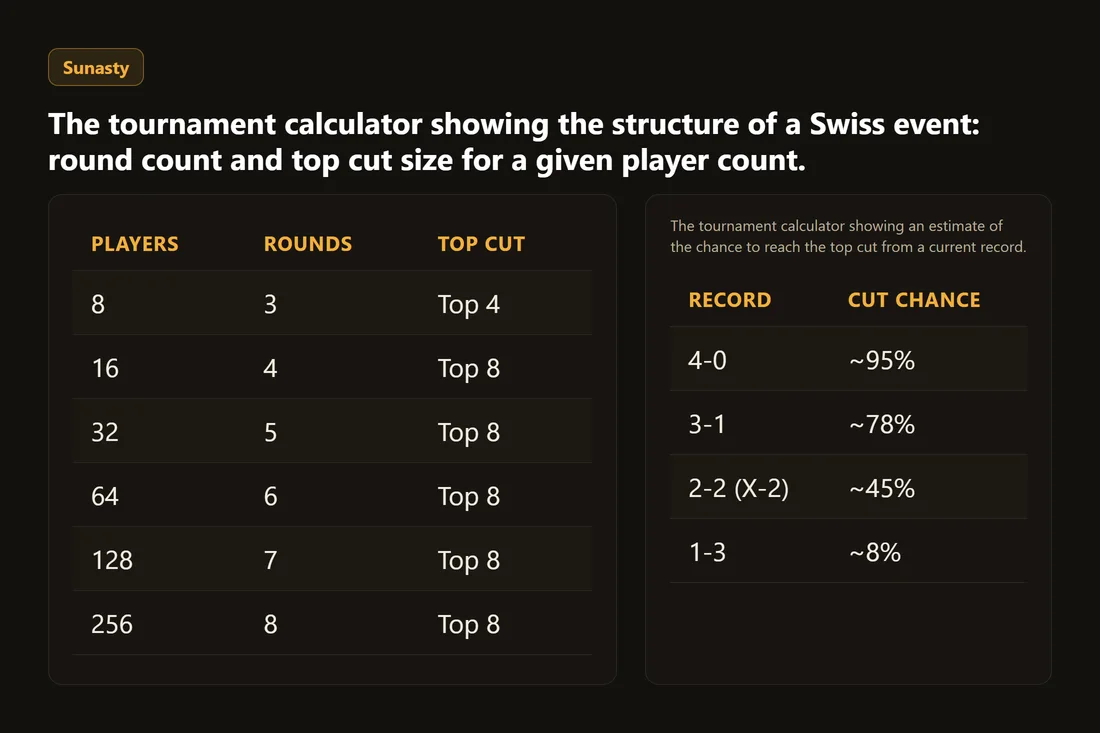
The round count is driven by attendance. The classic rule of thumb is the base-2 logarithm of the number of players rounded up, so 8 players need 3 rounds, 16 need 4, 32 need 5, 64 need 6 and 128 need 7. That is enough rounds for exactly one undefeated player to emerge on a best-case basis. Several games now publish their own tables that add a round or two on top of this baseline at higher tiers, so the exact number for a 200-person event depends on the game.
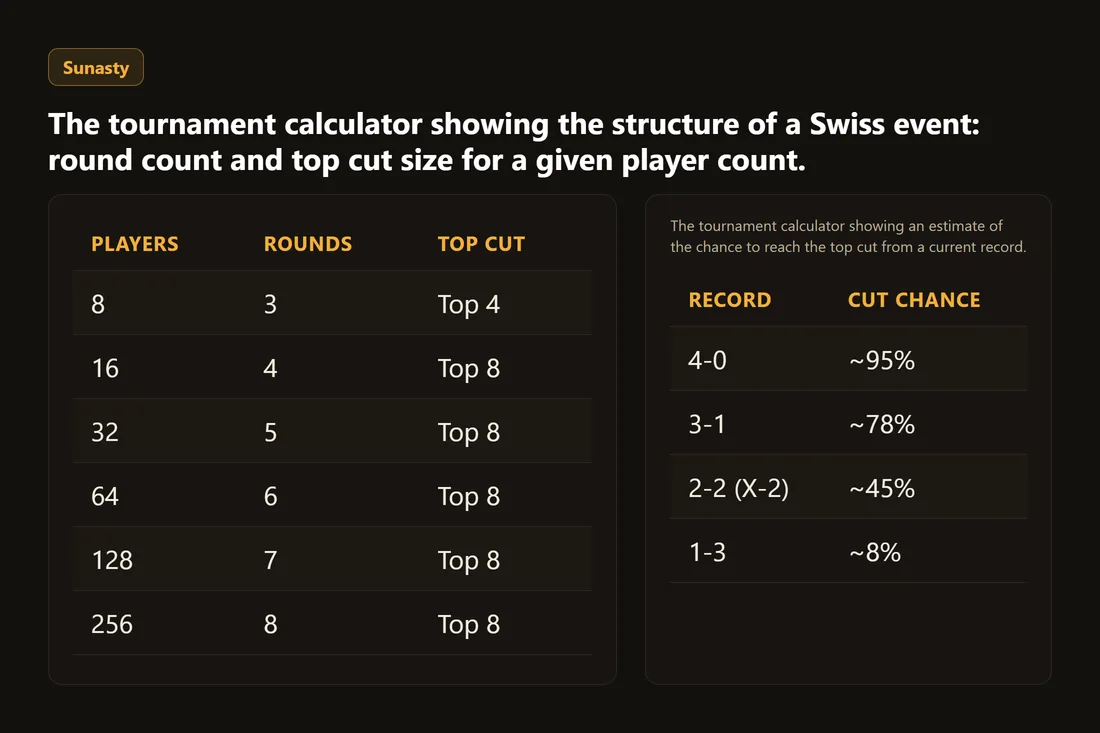
Top cut: the single-elimination playoff
After the Swiss rounds, the top-ranked players advance to a single-elimination bracket called the top cut, usually a Top 8. From there a single match loss knocks you out. The size of the cut depends on the game and the attendance: small events may have no cut at all and award placings straight from the Swiss standings, while large events seed the best 8, 16 or 32 players into the playoff.
What a bye means
A bye is a free round where you are not paired against an opponent. It usually happens when the field has an odd number of players, or it is awarded to high-ranked players at the start of a large event. In most games a bye counts as a match win for your record. There is one important exception worth knowing about: in a few systems a bye is handled differently from a normal win when tiebreakers are calculated, which can make it better or worse than playing the round out. The per-game articles cover this.
Tiebreakers: when records are equal
Many players finish on the same record, for example several at four wins and two losses, so the cut line falls in the middle of a group with identical points. Tiebreakers decide who gets in. The most common is opponents win percentage, which rewards you for facing a tougher schedule: if the people you beat kept winning, your own result looks stronger. Games stack several tiebreakers in order, typically your own match win percentage first, then your opponents win percentage, then game-level percentages. The practical takeaway is that you do not control your tiebreakers directly, so the players right on the bubble are at the mercy of how their past opponents finish.
Reading your record: the X-2 rule
A simple way to gauge whether you will make the cut is to count your losses. In most Top 8 events at a typical size, a record with two losses (often written X-2) is on the bubble: some players at X-2 make it on tiebreakers and some do not. One loss usually means you are safely in, and three losses usually means you are out. Drawing intentionally to lock a spot is allowed in some games and not others. Use the calculator to turn your remaining rounds and a win probability into a concrete estimate of your chances.
The math behind tiebreakers
The most common first tiebreaker is opponents match win percentage (OMW%): the average win rate of everyone you played. The idea is that a 5-2 built against strong opponents should rank above a 5-2 built against weak ones. Most systems apply a floor, often 33%, so a single opponent who drops at 0-3 cannot sink the tiebreakers of everyone who beat them in the early rounds. A bye is usually left out of this average entirely, which is part of why it is valuable: it gives you the match points of a win without attaching a weak opponent to your OMW%. When players are still tied, the next layer is often your own game win percentage (GW%): winning a best-of-three 2-0 counts for more than 2-1, so dropping games in matches you still win can quietly cost you the cut on the bubble.
This is an independent reference article. It is not affiliated with, endorsed by, or sponsored by any game publisher. All game names and trademarks belong to their respective owners. Always confirm the current rules with the official tournament policy for your event.
Frequently asked questions
What does X-2 mean?
X-2 is shorthand for any record with exactly two losses, regardless of the number of wins, such as 4-2 or 5-2. It is the record that most often lands on the top cut bubble, where tiebreakers decide who advances.
Why did I miss the cut with the same record as someone who made it?
Because of tiebreakers. When several players share a record, the cut line runs through that group, and tiebreakers such as opponents win percentage rank them. If your opponents lost more of their later rounds than the other player's opponents did, your tiebreakers are lower and you fall below the line.
How many rounds will my event have?
Count on roughly the base-2 logarithm of the attendance rounded up: 3 rounds for 8 players, 4 for 16, 5 for 32, 6 for 64, 7 for 128. Some games add a round or two at higher tiers, so check the official table for your game and event size.
Is a bye good or bad?
In most games a bye counts as a free match win, so it helps. The nuance is in tiebreakers: in some systems a bye is excluded from your opponents win percentage, which can make it strictly better than a real win, while in others it can hurt once you already have losses. The per-game articles spell out each case.