Article
Understand loans and interest
Interest is the price of borrowing money, but it is calculated in a few different ways, and the method changes the total a lot. This article walks through the ideas behind the numbers so the calculators on this site make sense. It is background reading, not financial advice.
Simple interest: the starting point
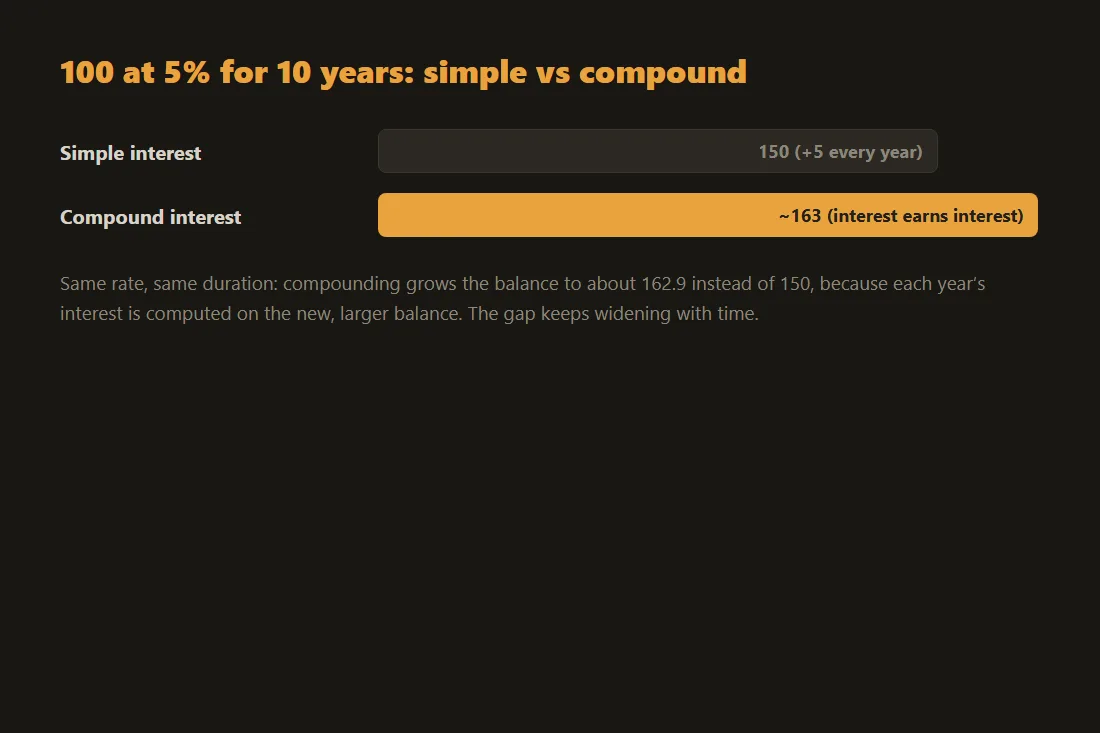
Simple interest is the easiest version to picture. You borrow an amount, called the principal, and you pay a fixed percentage of that original amount for each period, usually a year. Borrow 1,000 at 5 percent simple interest for three years and you owe 50 per year, so 150 in total on top of the 1,000. The interest never grows, because it is always figured on the first amount and nothing else. Pure simple interest is rare for long consumer loans, but it is the foundation everything else builds on, and some short-term loans behave close to it.
Compound interest: interest on interest
Compound interest is what most savings accounts and many loans actually use. Each period, the interest is added to the balance, and the next period charges interest on that larger balance. The growth speeds up over time because you are paying interest on past interest. How often it compounds matters: monthly compounding costs more than yearly compounding at the same headline rate. This is also why saving early matters so much and why a long, high-rate debt can balloon. The compound interest calculator lets you change the rate, the frequency and the years to see the effect for yourself.
Amortization: how a fixed monthly payment splits
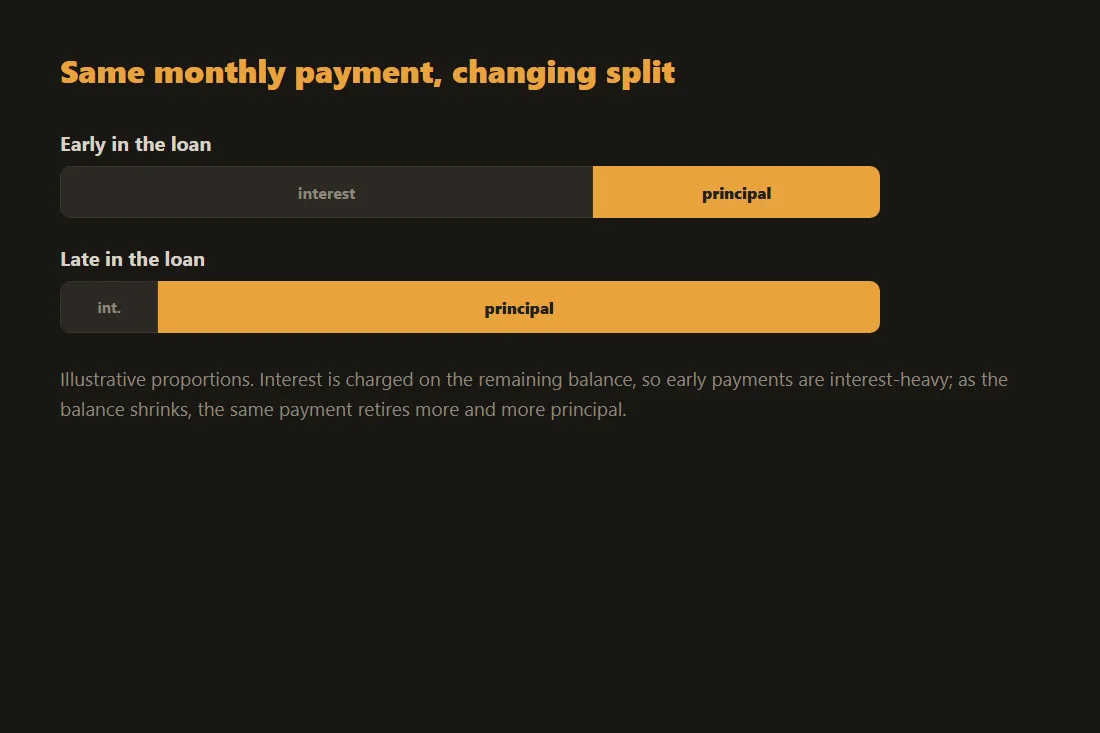
A mortgage or car loan usually has one fixed monthly payment, but that payment is split between interest and principal, and the split shifts every month. Early on, most of the payment covers interest because the balance is still large. As the balance falls, more of each payment chips away at the principal, so the loan pays down faster near the end. This schedule is called an amortization table. The loan calculator and mortgage calculator build it for you, which is why they can show a monthly figure and a total cost of credit from just the amount, rate and term.
Where an online simulator stops
A calculator on this site is a simulation, never financial advice. It models the math of interest, but it does not know your situation. Real offers add things these tools do not model: borrower insurance, application and administration fees, broker costs, and the rules and penalties around early repayment. Rates can also be variable rather than fixed, which changes every figure over time. Treat the result as a rough comparison, read the full offer from the lender, and consult a qualified financial advisor before committing to anything. For more on why these tools run entirely in your browser, see the related article on client-side processing.
The compound interest formula and why n matters
The standard compound interest formula is A = P(1 + r/n)^(nt), where A is the final amount, P is the principal, r is the nominal annual rate as a decimal, n is the number of compounding periods per year, and t is the time in years. The compounding frequency n has a real effect that the nominal rate alone does not reveal. A 5% annual rate compounded once per year on a 10,000 principal returns 10,500 after one year. The same rate compounded daily (n = 365) returns approximately 10,512.67. Over a 30-year term, this gap widens into thousands of additional currency units. Financial regulations in most jurisdictions require lenders to disclose the Annual Percentage Rate (APR), which folds the compounding frequency and fees into a single annualized figure so that different loan offers can be compared directly.
How the amortization formula distributes interest over time
The fixed monthly payment on an amortizing loan is given by M = P [ i(1 + i)^n ] / [ (1 + i)^n - 1 ], where P is the principal, i is the monthly interest rate (the annual rate divided by 12), and n is the total number of payments. In the first month, the interest portion equals the outstanding principal multiplied by i. Because the principal is at its maximum, interest consumes the largest share of M, and only the remainder (M minus that interest) reduces the balance. Each subsequent month, the outstanding principal is slightly smaller, so the interest portion falls and the principal reduction rises by the same amount. This creates a curve that is nearly flat at the start and steepens sharply toward the end of the term. Refinancing a 30-year mortgage after 10 years resets this curve to its starting point, which can cost more in total interest paid even if the new nominal rate is lower.
Tools in this article
- Loan CalculatorCalculate monthly payments, total cost and interest for any fixed-rate loan. 100% offline, no data leaves your device.
- Mortgage CalculatorEstimate your monthly mortgage payment (principal, interest, tax, insurance, PMI), 100% private, no upload.
- Compound & Simple Interest CalculatorCalculate compound or simple interest on any investment or loan, fully offline, nothing leaves your device.
Frequently asked questions
What is the difference between the rate and the total cost of credit?
The rate is the percentage used to calculate interest each period. The total cost of credit is the sum of all the interest you pay over the whole loan, and it depends on the rate, the amount and how long you take to repay. A lower rate over a longer term can still cost more in total than a higher rate repaid quickly, which is why comparing the total, not just the rate, is more honest. Remember the calculator leaves out insurance and fees, so a real offer usually costs more than the figure shown.
Do these calculators send my numbers anywhere?
No. The loan, mortgage and compound interest calculators run entirely in your browser, so the amounts you type stay on your device and are not sent to any server. You can open your browser developer tools and watch the Network tab while you compute, and you will see no request carrying your figures. The tradeoff is honesty about scope: the math is private and correct, but it is still a simplified model, not a substitute for advice from a professional.