Article
Magic: The Gathering tournament structure: rounds, Top 8 and tiebreakers
Magic has the longest-running and most-copied tournament structure in the hobby. This article covers how a typical constructed or limited event is built: the number of Swiss rounds, the Top 8 cut, the points each result is worth, and the four-level tiebreaker stack that decides the bubble.
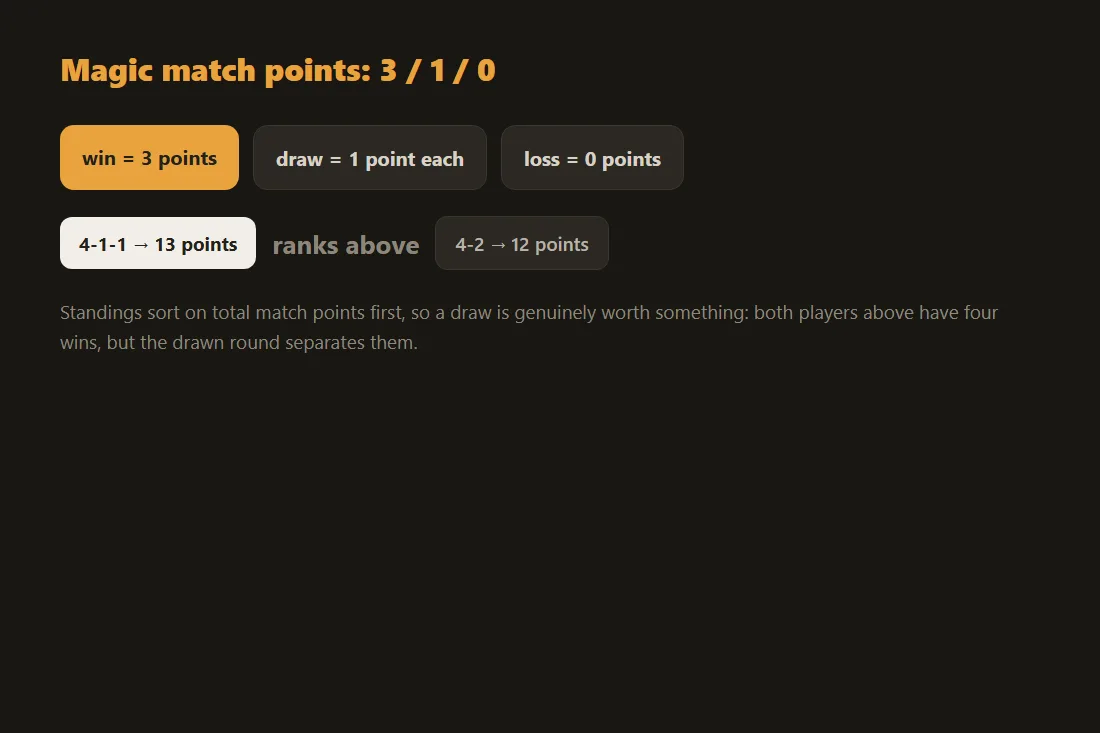
Points: 3 for a win, 1 for a draw, 0 for a loss
Magic matches are best of three games. A match win is worth 3 points, a draw is worth 1 point each, and a loss is worth 0. Standings are sorted by total match points first, so a player at 4-1-1 (13 points) sits above a player at 4-2 (12 points) even though both have four wins. This points system is the foundation that the round count and tiebreakers build on.
How many rounds
The Magic Tournament Rules publish a recommended round table in Appendix E, and it follows the base-2 logarithm pattern: 8 players play 3 rounds, 9 to 16 play 4, 17 to 32 play 5, 33 to 64 play 6, 65 to 128 play 7, and so on. The aim is to produce a clean Top 8 where the bracket is meaningful, so the round count is tuned to the attendance.
Top 8 cut
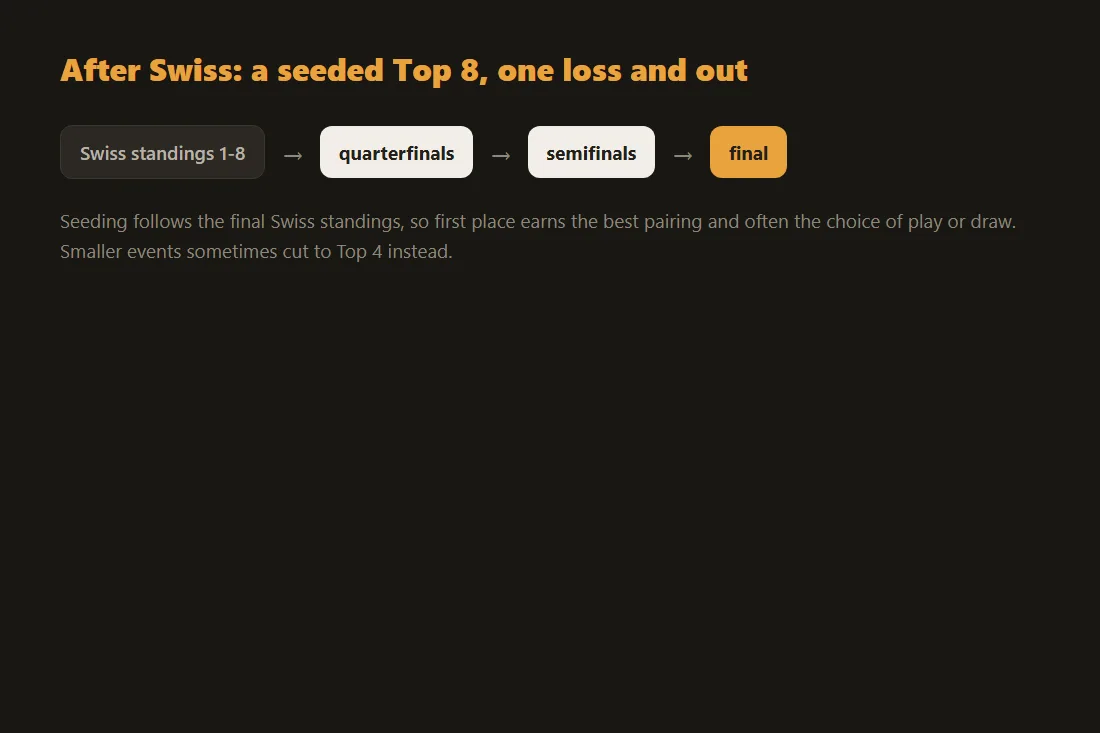
After Swiss, the top eight players advance to a single-elimination bracket. Smaller events sometimes cut to Top 4. Seeding in the bracket follows the final Swiss standings, so finishing first in Swiss earns the best pairing and, in many formats, the choice of play or draw. From the Top 8 onward, one match loss ends your run.
Intentional draws
Magic allows intentional draws. Two players can agree to record their match as a draw without playing, each taking 1 point. Near the end of Swiss this is a real strategic tool: if a draw locks both players into the Top 8 on points and tiebreakers, they can avoid the risk of a loss. Whether a draw is safe depends on the standings and the tiebreakers of everyone on the bubble, which is exactly what the calculator helps you reason about.
The tiebreaker stack
When players are tied on match points, Magic breaks the tie in this order: opponents' match win percentage, then game win percentage, then opponents' game win percentage. Match win percentage and game win percentage both have a floor of 33 percent so that a single crushing result cannot distort the math. The headline tiebreaker is opponents' match win percentage, which rewards a tough schedule, so two players at the same record can be separated entirely by how their past opponents performed.
The three-layer tiebreaker system in EventLink
Magic: The Gathering uses Wizards EventLink to manage Swiss pairings. Match points follow a 3-1-0 scale: 3 for a win, 1 for a draw, 0 for a loss. When players share the same total, EventLink resolves the tie through three ordered layers. First, Opponents' Match Win Percentage (OMWP): the average win rate of every opponent faced, with a 0.33 floor so that any opponent is counted as at least one-third even if they finished 0-5. Second, Game Win Percentage (GWP): the share of individual games won. A 2-0 match win contributes 100 percent for that round; a 2-1 win contributes roughly 67 percent. Dropping games therefore costs more than just the round result. Third, Opponents' Game Win Percentage (OGWP): the average GWP of all opponents, consulted only when both prior tiebreakers are equal.
Intentional draws and the cut line
Magic explicitly permits Intentional Draws (IDs): both players agree before playing to report a 0-0-3 result, each receiving 1 match point. At events such as Regional Championship Qualifiers or large open tournaments, calculating the cut line entering the final round is a practical skill. If reaching 13 match points is the threshold for Top 8, two players sitting at 12 points can ID to reach 13 and secure their places rather than risk a loss that would leave them at 12. However, drawing lowers your GWP compared with winning, and it leaves your OMWP unchanged rather than boosted, so an ID at the low end of the qualifying bracket can still be knocked out of the cut by a tiebreaker comparison with players who won outright.
How byes are handled in EventLink
A bye in Magic is awarded when the number of players is odd, or it can be earned through qualifying performance at prior events. EventLink treats a bye as a 2-0 match win for points purposes, contributing 3 match points to the receiving player. Crucially, the bye round has no opponent, so it is excluded entirely from the OMWP denominator. This means the bye does not introduce a placeholder record into your strength-of-schedule calculation. The player simply accrues the win and the match points, and all OMWP calculations proceed as if that round did not happen from an opponent perspective.
This is an independent reference article. It is not affiliated with, endorsed by, or sponsored by any game publisher. All game names and trademarks belong to their respective owners. Always confirm the current rules with the official tournament policy for your event.
Frequently asked questions
How many rounds for my Magic event?
Use Appendix E of the Magic Tournament Rules: 3 rounds up to 8 players, 4 for 9 to 16, 5 for 17 to 32, 6 for 33 to 64, 7 for 65 to 128. Larger events add rounds from there.
Can I draw into Top 8?
Often, yes. Magic permits intentional draws, and in the final Swiss round players on the bubble sometimes draw to lock a spot. It only works if the resulting points and tiebreakers keep both players above the cut line, so check the standings first.
What is the first tiebreaker in Magic?
Among players tied on match points, the first tiebreaker is opponents match win percentage, which measures the strength of the opponents you played. Your own match win percentage decides ordering at the points level before that.
Why is there a 33 percent floor on tiebreakers?
Each opponent's win percentage is treated as no lower than 33 percent. This stops one opponent who dropped early with a terrible record from dragging your tiebreakers down unfairly, keeping the comparison between tied players fair.