Article
Disney Lorcana tournament structure: rounds, top cut and tiebreakers
Disney Lorcana, published by Ravensburger, runs its organized play as Swiss followed by a top cut, with thresholds set by attendance. This article explains the match format, how rounds and the cut scale, and how the standings are decided.
Best of three Swiss
Lorcana Swiss rounds are timed and played as best of three games. A game win counts toward the match, and match results convert to standings points in the familiar 3 for a win and 1 for a draw pattern. A tournament needs a minimum of eight players to be officially sanctioned, and at least three Swiss rounds are played for the event to count.
How draws happen
Lorcana has a specific draw rule inside a game. If neither player has won by the end of a defined set of extra turns and the game wins are level, the match is recorded as a draw and the unfinished game does not count toward the result. That keeps the round on schedule while still giving a fair outcome when time runs out with no clear winner.
Rounds by attendance
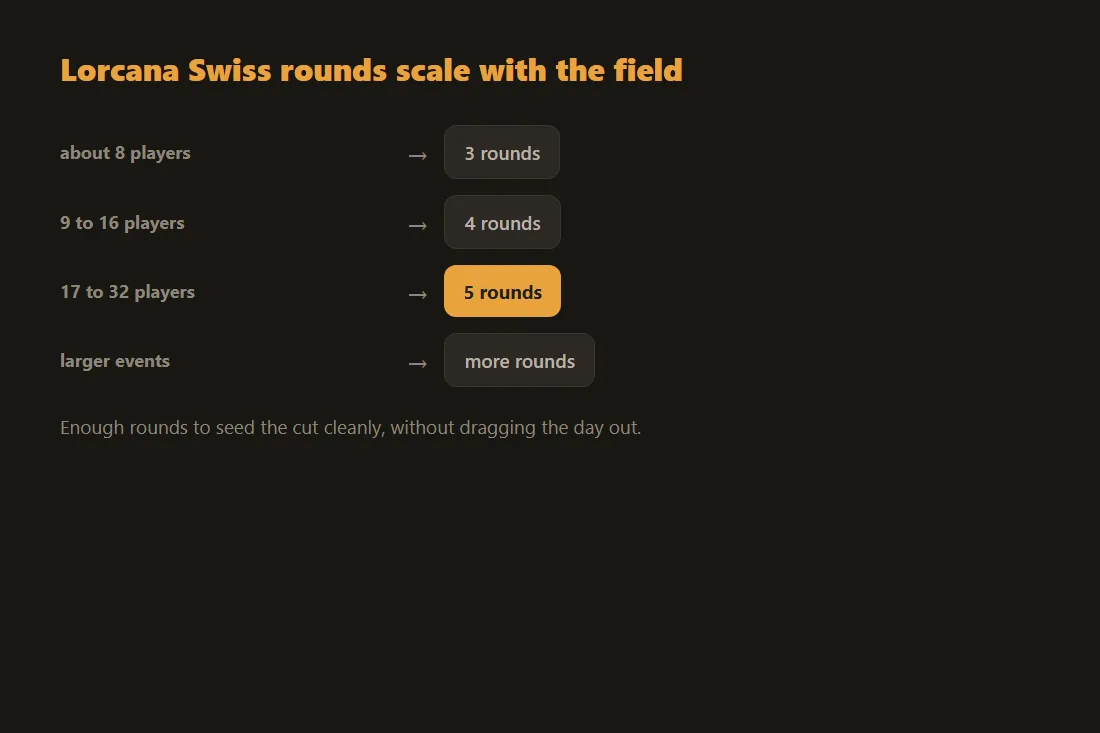
The number of Swiss rounds scales with the field. A small event around eight players runs about three rounds; nine to sixteen players run four; and seventeen to thirty-two run five, with larger events adding more. As always the goal is to play enough rounds to seed the cut cleanly without dragging the day out.
Top cut thresholds
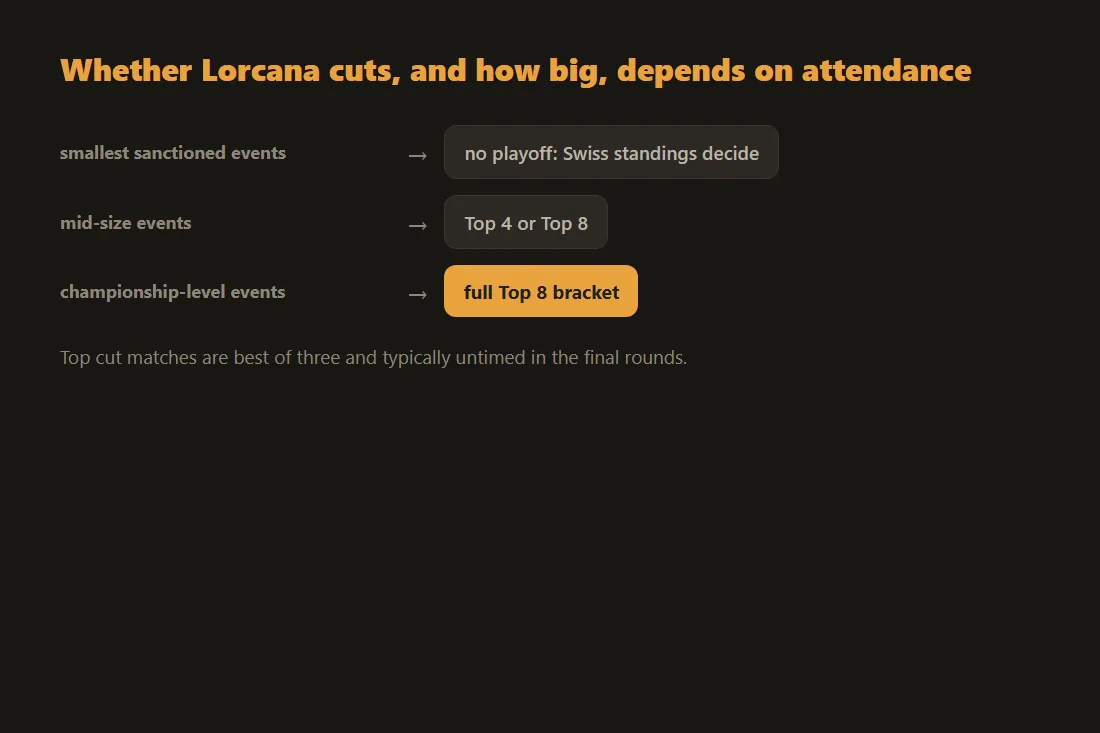
Whether there is a top cut, and how big, depends on attendance. The smallest sanctioned events award placings from the Swiss standings with no playoff. Mid-size events introduce a Top 4 or Top 8, and larger championship-level events run a full Top 8 bracket. Top cut matches are best of three and typically untimed in the final rounds.
Standings and tiebreakers
Players are ranked by match points, and ties are broken by strength-of-schedule percentages in the same spirit as other trading card games: first your opponents' match win percentage, then your opponents' opponents' match win percentage. So two players at the same record are separated by how well the people they played, and the people those people played, went on to do, which means the bubble is decided by results you do not control.
How points accumulate under best-of-three
Disney Lorcana competitive events, including Set Championships and Disney Lorcana Challenge (DLC) tournaments, are commonly managed through Melee.gg, but the match structure is the same best-of-three described above: standings track match points only (3 for a win, 1 for a draw, 0 for a loss), not individual games won. A hard-fought 2-1 win and a clean 2-0 sweep are worth exactly the same three points in the round they happen; the margin only matters indirectly, through the beaten opponent's own match record feeding into other players' tiebreakers later in the event.
Tiebreaker calculations in detail
When players are level on match points, two tiebreakers apply in sequence. First, Opponents' Match Win Percentage (OMWP): the average match win rate of every opponent you faced, with a floor so that a single poor-performing opponent who drops early does not collapse your tiebreaker on its own. Second, Opponents' Opponents' Match Win Percentage (OOMWP): the average OMWP of all the opponents you faced, used only when the first tiebreaker is identical between two players.
Drops and the top-cut bubble
The bubble for a top cut can still get crowded around the cutoff line, especially in a Swiss field where draws are possible. When opponents drop from the tournament before it concludes, their match win percentage is fixed at whatever record they held at the time of departure. An opponent you beat in Round 1 who then drops in Round 3 with a poor record will lower your OMWP. Competitive players in contention for top cut often track the ongoing records of past opponents during the day, because a wave of drops from an early round can shift the tiebreaker ordering before the final standings are locked.
This is an independent reference article. It is not affiliated with, endorsed by, or sponsored by any game publisher. All game names and trademarks belong to their respective owners. Always confirm the current rules with the official tournament policy for your event.
Frequently asked questions
How many players make a Lorcana tournament official?
An event needs at least eight players present and ready to be officially sanctioned, and it must play a minimum of three Swiss rounds. Below that threshold it should be reported as cancelled.
How do draws work in Lorcana?
If neither player has secured the match by the end of the defined extra turns and the game wins are tied, the match is a draw and the unfinished game is not counted. Each player takes the draw result in the standings.
Does every Lorcana event have a top cut?
No. The smallest sanctioned events award placings straight from Swiss. A Top 4 or Top 8 appears as attendance grows, and championship events run a full Top 8 bracket.
How are ties in the standings broken?
By strength of schedule. After match points, the tiebreakers compare your opponents' win percentage and then your opponents' opponents' win percentage, so a tougher schedule ranks you above tied players who had an easier one.