Article
One Piece Card Game tournament structure: Swiss, Top 8 and points
The One Piece Card Game, run by Bandai Organized Play, uses a Swiss stage followed by a single-elimination Top 8. Its defining trait among the major games is that Swiss rounds are best of one, which changes how variance feels during the day.
Best of one Swiss
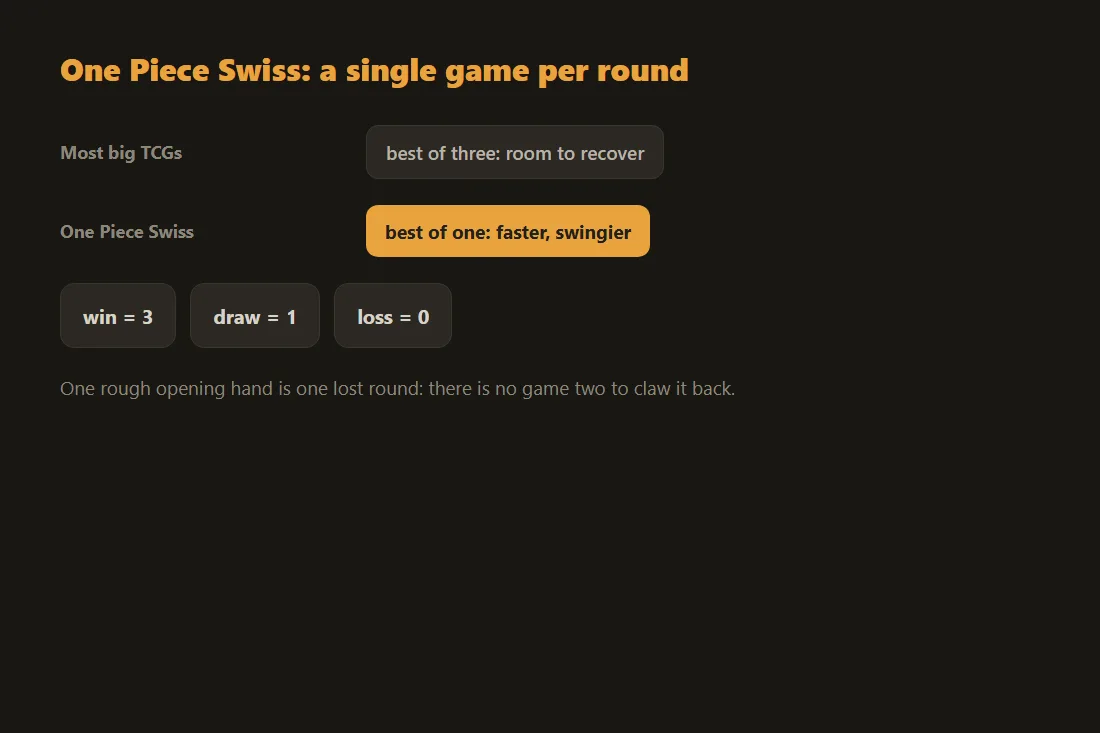
Unlike most of the big trading card games, One Piece plays its Swiss rounds as a single game rather than best of three. A win is worth 3 points, a draw 1, and a loss 0, and standings are sorted on those points. Best of one makes each round faster but also swingier, since there is no second or third game to recover from a rough opening.
How many rounds
Bandai sets the number of Swiss rounds from attendance using its tournament rules manual, designed so that on a best-case basis one undefeated player remains after the final round. In practice this tracks the same base-2 logarithm shape used elsewhere, with the exact figure for a given headcount taken from the manual rather than guessed.
Top 8 cut
After Swiss, the top eight players advance to a single-elimination Top Cut Finals. This lets every player take part in every Swiss round while still giving those without a perfect record a path to win the event through the bracket. From the Top 8 on, a single loss ends your day.
How byes are scored
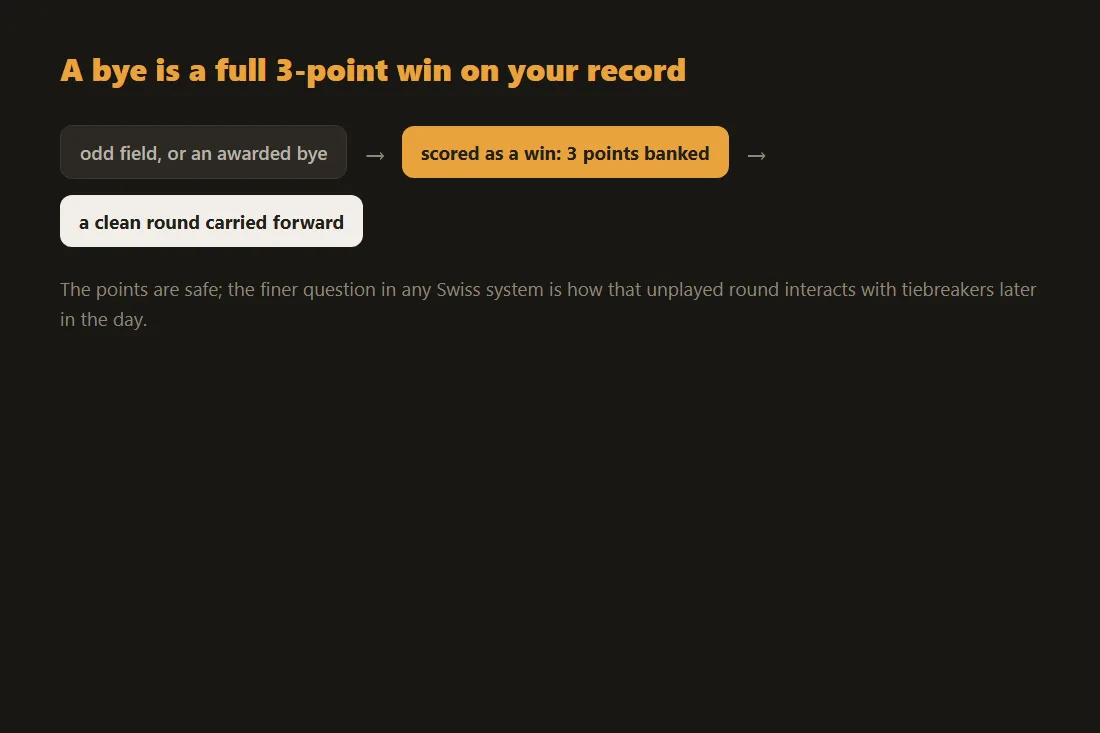
When the field is odd or a bye is otherwise awarded, the bye is scored as a win worth the full three points for your record. As in every Swiss system, the finer question is how the bye interacts with tiebreakers, so if you receive one, the points are banked and you carry a clean round into the rest of the event.
Standings and tiebreakers
Players tied on points are separated by strength-of-schedule tiebreakers based on the records of their opponents, following the standard Swiss approach. Because Swiss is best of one, results can cluster tightly, so the tiebreaker comparison among players on the same points total often decides several bracket spots at once.
Best-of-One Swiss and round counts
One Piece Card Game competitive events, including Regionals and Treasure Cup qualifiers, run through the Bandai TCG Plus platform. Swiss rounds use a Best-of-One format with a 35-minute timer per round, rather than the best-of-three structure common in most major card games. This creates high variance: a single poor opening hand or unfavorable matchup produces an immediate match loss with no recovery game. Round counts at large Regionals frequently reach 9 or 10 rounds of Swiss. In a 9-round event, a 2-loss record is almost always outside the top cut. Maintaining an undefeated or single-loss record is typically required to advance.
Double losses and Bandai time rules
When the 35-minute timer expires in a One Piece match, both players receive three additional turns to complete the game. If neither player has won after those three turns, the match ends as a Double Loss, and both players receive 0 match points. In an event where a second loss is typically fatal to top-cut chances, a Double Loss carries the same standing impact as a regular loss but eliminates the possibility of either player recovering. This discourages very slow play styles, since running out time deliberately is never a viable strategy: a draw result does not help either player's record.
Tiebreaker math in Bandai TCG Plus
Match points in One Piece events follow a simple scale: 3 for a win, 1 for a draw, and 0 for a loss or a double loss. When players share the same match point total, Bandai TCG Plus applies two tiebreakers in order. First, Opponents' Match Win Percentage (OMWP): the average win rate of all opponents faced. Unlike some other systems, Bandai does not apply a generous floor here, so opponents who finish with a very poor record weigh materially on your OMWP. Second, Opponents' Opponents' Match Win Percentage (OOMWP): the average OMWP of those same opponents, reflecting the overall strength of your schedule. Because large Regionals draw fields of one thousand players or more, the cut line for Top 16 or Top 32 is often separated by small OMWP differences, making opponent quality in pairing-down scenarios particularly consequential.
This is an independent reference article. It is not affiliated with, endorsed by, or sponsored by any game publisher. All game names and trademarks belong to their respective owners. Always confirm the current rules with the official tournament policy for your event.
Frequently asked questions
Is One Piece best of one or best of three?
Swiss rounds in the One Piece Card Game are best of one, a single game per round. The Top 8 bracket may use a different format per the event rules, but the Swiss stage is one game.
How big is the top cut?
The standard cut is a Top 8 single-elimination Finals after the Swiss rounds, so the best eight players from the standings advance to the bracket.
How is a bye scored?
A bye counts as a win worth three points toward your record, the same as winning a game on the table. It keeps your round count clean when the field is odd or when a bye is awarded.
Why does best of one feel so swingy?
With only one game per round there is no chance to adjust after seeing your opponent's deck or to recover from a slow draw. That raises variance, so a strong record in One Piece Swiss reflects both skill and a degree of consistency under single-game pressure.