Article
Flesh and Blood tournament structure: Swiss, Top 8 and why a bye can hurt
Flesh and Blood, by Legend Story Studios, runs Swiss followed by a Top 8, but its tiebreaker math has a twist that catches players out: once you have a loss, a bye can be worse for your standing than a draw. This article explains why.
Best of one Swiss
Flesh and Blood Swiss rounds are best of one. A win earns a point, a draw earns nothing for either player, and a loss earns nothing, with standings ordered by wins first. Because each round is a single game, the day moves quickly and a clean record is built one game at a time.
How many rounds
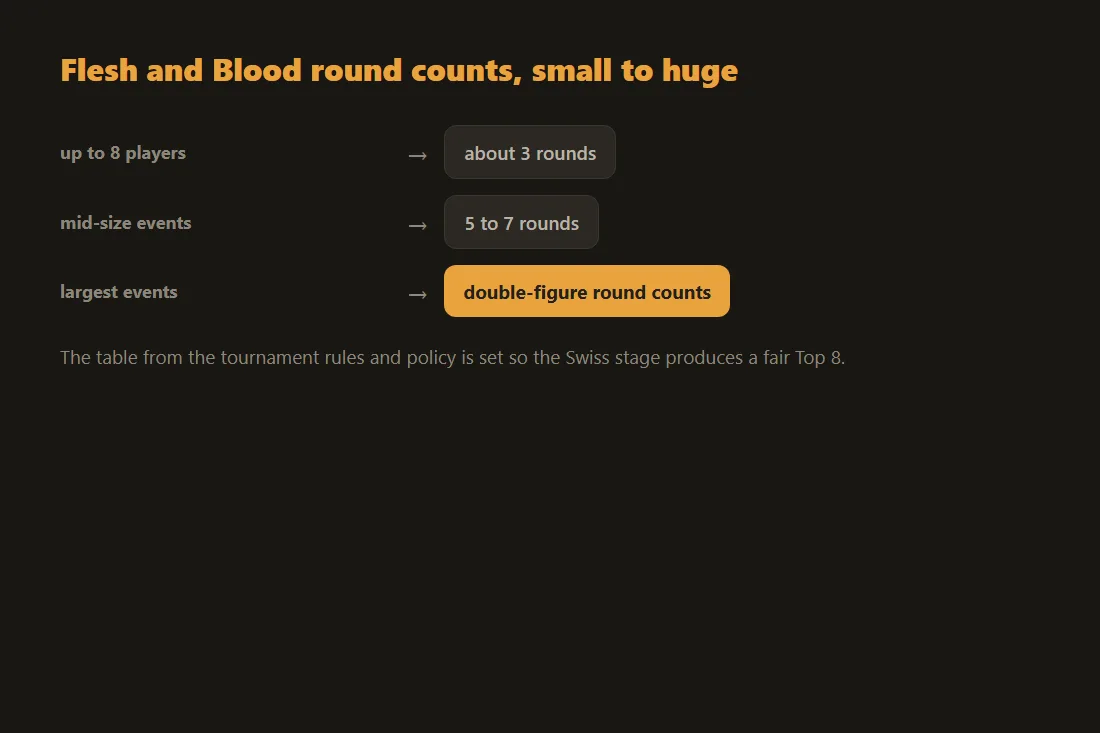
The round count scales with attendance from the tournament rules and policy. Events up to eight players run about three rounds; the count climbs through the brackets so that mid-size events run five to seven rounds and the very largest events run into double figures. The table is set so that the Swiss stage produces a fair Top 8.
Top 8 cut
After Swiss, the top eight players advance to a single-elimination bracket. Seeding follows the final standings, so a higher Swiss finish earns a better bracket position. From the Top 8 onward the event is win-or-go-home in the usual single-elimination way.
The match loss percentage tiebreaker
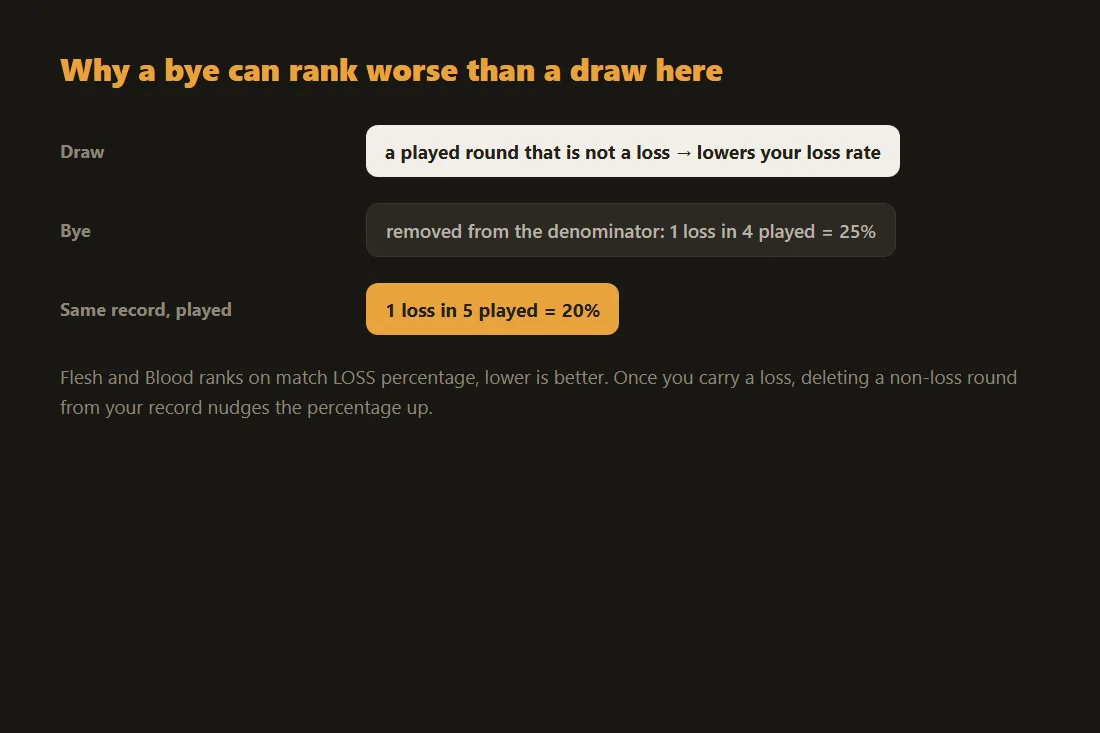
The key tiebreaker in Flesh and Blood is match loss percentage, the average fraction of your matches that were losses. A lower figure is better. A draw counts as a played round that was not a loss, so it lowers your average loss rate. A bye, by contrast, is treated as a round you did not play at all, so it is removed from the denominator. Once you already carry a loss, removing a non-loss round from your record nudges your loss percentage upward, which is why a bye can rank worse than a draw.
What that means in practice
If you are undefeated, a bye is harmless because you have no losses to average against. The moment you pick up a loss, a bye stops helping your tiebreaker and a draw would have been gentler on it. You rarely get to choose, but understanding the rule explains why two players with similar records can be seeded differently, and why the bubble in Flesh and Blood rewards simply losing fewer matches.
Tiebreaker calculation in GEM
Flesh and Blood tournaments run through GEM (Game Event Manager), the official software from Legend Story Studios. Classic Constructed uses Best-of-One rounds of 50 minutes, so match points are binary: 1 for a win, 0 for a loss or a draw. When players share the same point total, GEM resolves ties through two layers. First, Opponents' Match Win Percentage (OMWP): the average win rate of every opponent you faced, with a floor of 0.33 to prevent a struggling opponent from dragging your schedule strength below one-third. Second, Opponents' Opponents' Match Win Percentage (OOMWP): the average OMWP of those same opponents, measuring the depth of your bracket. There is no Game Win Percentage in FaB because single-game rounds make it meaningless. Draws, while rare, yield zero points, the same outcome as a loss.
The Elo rating and seeding
Unlike most trading card games, Flesh and Blood publishes a rolling Elo rating for every player, tracked across three windows: XP (lifetime), 90-day, and the current season. Elo is not used as a Swiss tiebreaker, but it drives initial seeding and pair-downs at major events such as Pro Tours and National Championships. Players seeded higher are paired against higher-ranked opponents in early rounds. Winning those matches raises your OMWP substantially, because your opponents already have strong records. This gives high-Elo players a structural benefit on the top-cut bubble, where fractions of a percentage point in OMWP can separate two players with identical match point totals.
Byes and ProQuest value
Byes in Flesh and Blood are awarded through ProQuest seasons or by accumulating substantial Lifetime XP. In GEM, a bye counts as a win (1 point) but contributes no opponent to the OMWP calculation. The bye round is excluded from the denominator entirely, so it does not add a phantom opponent with a weak record to your strength of schedule. In practice, a Day 1 bye at a Calling or National Championship means you enter Round 2 with a clean 1-0 record and an OMWP denominator drawn entirely from real, competitive opponents. At a deep event where the top-cut line is decided by fractions of a percentage point, that clean starting position can matter in the final standings.
This is an independent reference article. It is not affiliated with, endorsed by, or sponsored by any game publisher. All game names and trademarks belong to their respective owners. Always confirm the current rules with the official tournament policy for your event.
Frequently asked questions
Is a bye good in Flesh and Blood?
Only if you are undefeated. A bye is treated as an unplayed round, so it leaves the match loss percentage tiebreaker untouched when you have no losses. Once you have a loss, that removed round makes your loss percentage slightly worse than if you had drawn instead.
Why is a draw better than a bye here?
A draw is a played round that was not a loss, so it lowers your average loss rate. A bye is removed from the count entirely, so it cannot lower the rate and, with a loss already on record, effectively raises it. That is the quirk of the match loss percentage tiebreaker.
What is the main tiebreaker?
Match loss percentage, the average share of your matches that were losses, where lower is better. It rewards consistency: the player who lost the fewest matches on average ranks higher among players tied on wins.
How big is the cut?
The standard playoff is a single-elimination Top 8 after the Swiss rounds, seeded by the final standings.