Article
The Gregorian leap year rule, explained
Most people learn one test for leap years: divisible by 4. That shortcut works for every year you are likely to meet, and then fails exactly when it matters. 1900 was not a leap year, 2100 will not be one either, yet 2000 was. The full Gregorian rule has three steps, it exists for a precise astronomical reason, and once you have seen why, the exceptions stop feeling arbitrary.
The rule in three steps
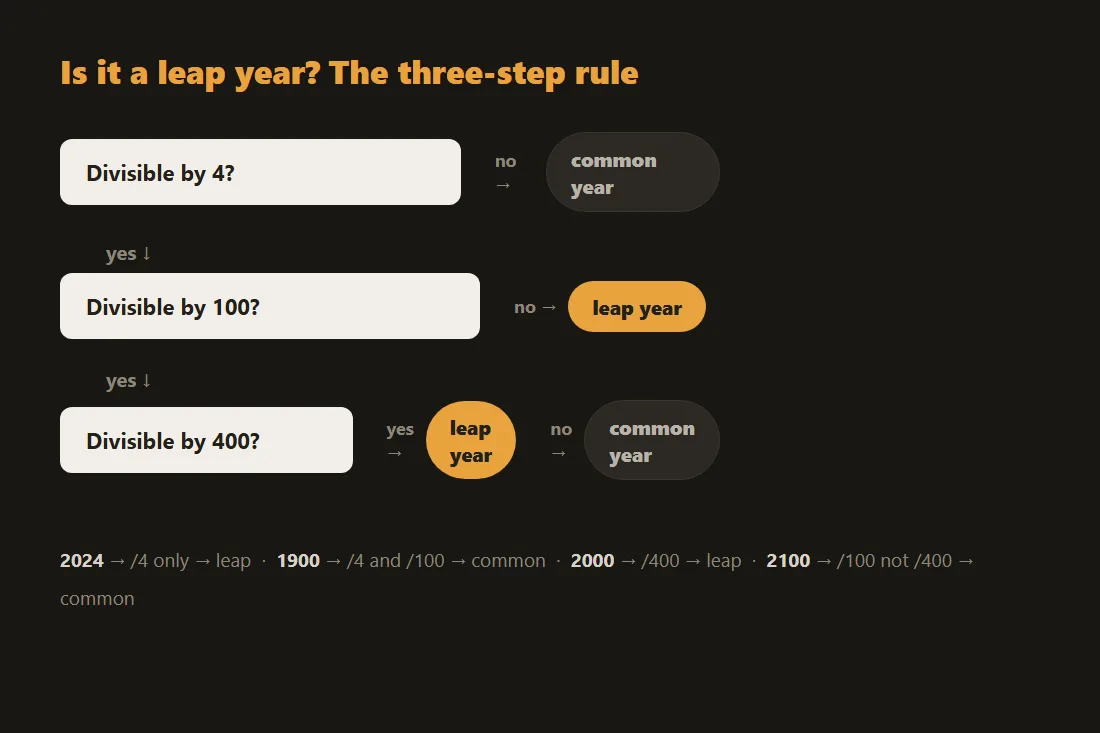
A year is a leap year if it is divisible by 4. Exception: if it is also divisible by 100, it is not. Exception to the exception: if it is divisible by 400, it is a leap year after all. Applied in order: 2024 passes the first test and neither exception, so it has a February 29. 1900 is divisible by 4 and by 100 but not by 400, so it stays a common year of 365 days. 2000 is divisible by all three, so it was a leap year, which is why many people alive today have never actually seen the century exception fire. The next time it does is 2100.
Why the calendar needs correcting at all
The Earth does not orbit the Sun in a round number of days. One tropical year, equinox to equinox, lasts about 365.2422 days: 365 days, 5 hours, 48 minutes and 45 seconds. A 365-day calendar drifts against the seasons by almost 6 hours every year, a full day every 4 years or so. The Julian calendar, introduced in 45 BC, fixed most of that with one leap day every 4 years, giving an average year of 365.25 days. Close, but 11 minutes and 14 seconds too long. Eleven minutes a year sounds harmless; over 128 years it adds up to a full day, and by the 16th century the spring equinox had slid about 10 days early in the calendar, dragging the date of Easter with it.
The 1582 correction, and the long road to adoption
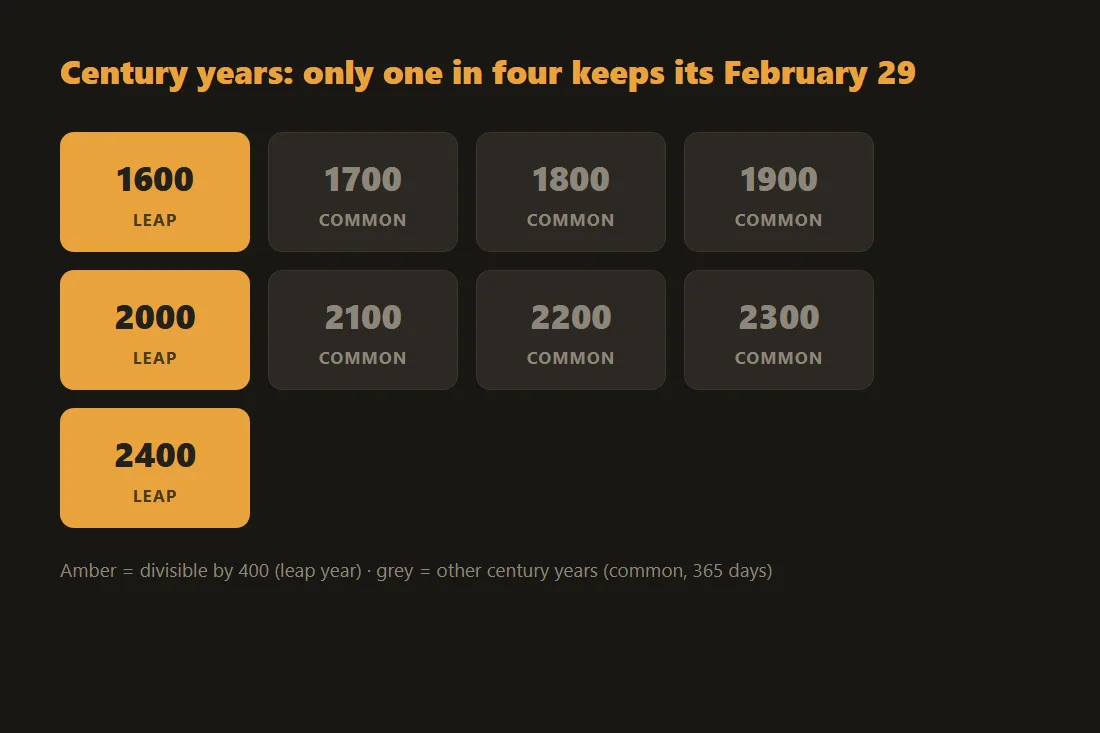
The Gregorian reform, set out in the papal bull Inter gravissimas of 1582, did two things. It removed the accumulated drift in one stroke: in the countries that adopted it immediately, Thursday 4 October 1582 was followed by Friday 15 October 1582, ten dates skipped outright. And it changed the leap rule going forward, dropping 3 leap days every 400 years by demoting the century years not divisible by 400. Adoption took centuries. Catholic states switched in the 1580s; Great Britain and its colonies waited until 1752, by which point the correction had grown to 11 days; Russia only switched after 1918, which is why the October Revolution took place in November of the Gregorian calendar.
How accurate is the fixed calendar?
The Gregorian average year is 365 + 1/4 - 1/100 + 1/400 = 365.2425 days, against a tropical year of about 365.2422. The remaining error is roughly 27 seconds a year, or one day in about 3,200 years. No official rule exists yet for correcting that; proposals like skipping a leap year around the year 4000 have been floated but never adopted, and the tropical year itself shifts slowly, so legislating that far ahead makes little sense. One thing the leap day is not: a cousin of the leap second. Leap seconds adjust atomic time (UTC) to the Earth's irregular rotation, on a scale of seconds; the leap day adjusts the calendar to the orbit, on a scale of days. Different problems, different mechanisms.
Checking a year without memorizing anything
For a century year, drop the two zeros and test what remains against 4: for 2000, 20 divides by 4, leap; for 2100, 21 does not, common. For any other year, the last two digits alone decide: 2038 ends in 38, not divisible by 4, common year. If you would rather not do arithmetic at all, our leap year checker tells you directly whether any year, past or future, has a February 29, and the date info tool breaks down any date (day of year, week number, days in the month). Both run entirely in your browser: nothing you type is sent anywhere.
Tools in this article
Frequently asked questions
Is 2100 a leap year?
No. 2100 is divisible by 4 and by 100, but not by 400, so the century exception applies and February 2100 has 28 days. The same happened in 1700, 1800 and 1900, and will happen in 2200 and 2300. The next century year WITH a February 29 is 2400. Software gets this right: every serious date library implements the full three-step rule, so your phone will not be confused in 2100.
Why does February get the extra day?
Because of where the Roman year used to end. In the pre-Julian Roman calendar, February was the last month and already the place where the priests inserted extra time to realign the year. The Julian reform kept the habit: the extra day was created by doubling the sixth day before the calends of March, in Latin "bis sextus", which is where French bissextile and similar words in many languages come from. Modern calendars simply kept February as the month that stretches.
Do other calendars handle this differently?
Yes. The Julian calendar, still used by some Orthodox churches, keeps the plain every-4-years rule and is now 13 days behind. The Solar Hijri calendar used in Iran and Afghanistan places leap days by astronomical observation and is more accurate than the Gregorian rule. Lunisolar calendars, like the Hebrew and Chinese ones, insert a whole leap month several times per 19-year cycle instead of a leap day. The Gregorian trade-off is that it stays close enough to the seasons using nothing but simple integer arithmetic.