Article
ISO week numbers, explained
In much of Europe a meeting can be scheduled for "week 27" with no date attached. Ask a spreadsheet, a US calendar app and a German paper diary which week that is, and the answers can differ by one, sometimes two. Week numbering is not one convention but several, and ISO 8601 defines the unambiguous one: weeks start on Monday, week 1 is anchored to the first Thursday of January, and the price of that precision is a week 1 that can start in December and years that count 53 weeks.
Two rules define the ISO week
The ISO 8601 week starts on Monday, and its days are numbered 1 (Monday) through 7 (Sunday). Week 1 of a year is the week that contains the first Thursday of January, or equivalently the week that contains 4 January. One consequence is worth keeping in mind: at least four of the seven days of week 1 belong to the new year, so the majority of a week decides which year it counts under. Written out, an ISO week date looks like 2026-W27-5: year 2026, week 27, day 5, a Friday. A compact form without hyphens (2026W275) exists too, but schedules and project plans almost always use the hyphenated one.
The week year is not the calendar year
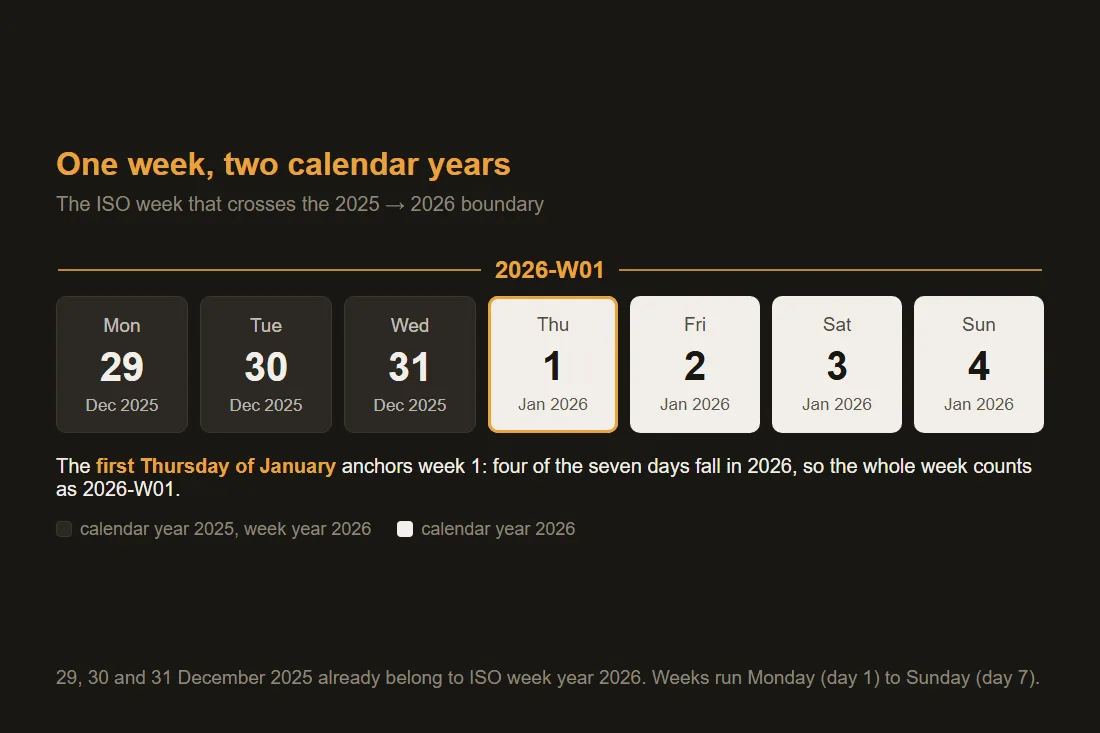
Because week 1 is anchored to the first Thursday, up to three days of late December can already belong to week 1 of the next year, and up to three days of early January can still belong to the last week of the previous one. The current boundary is a live example: Monday 29 December 2025 through Sunday 4 January 2026 form a single week, 2026-W01, so 29, 30 and 31 December 2025 carry the week-numbering year 2026. This split is the source of a classic software bug. Date formatters distinguish the calendar year (yyyy in Java-style patterns) from the week-based year (YYYY), and code that prints YYYY by mistake shows the wrong year for a few days around New Year. A bug of exactly this family hit Twitter's date display at the end of 2014, and it resurfaces somewhere every December.
Some years have 53 weeks
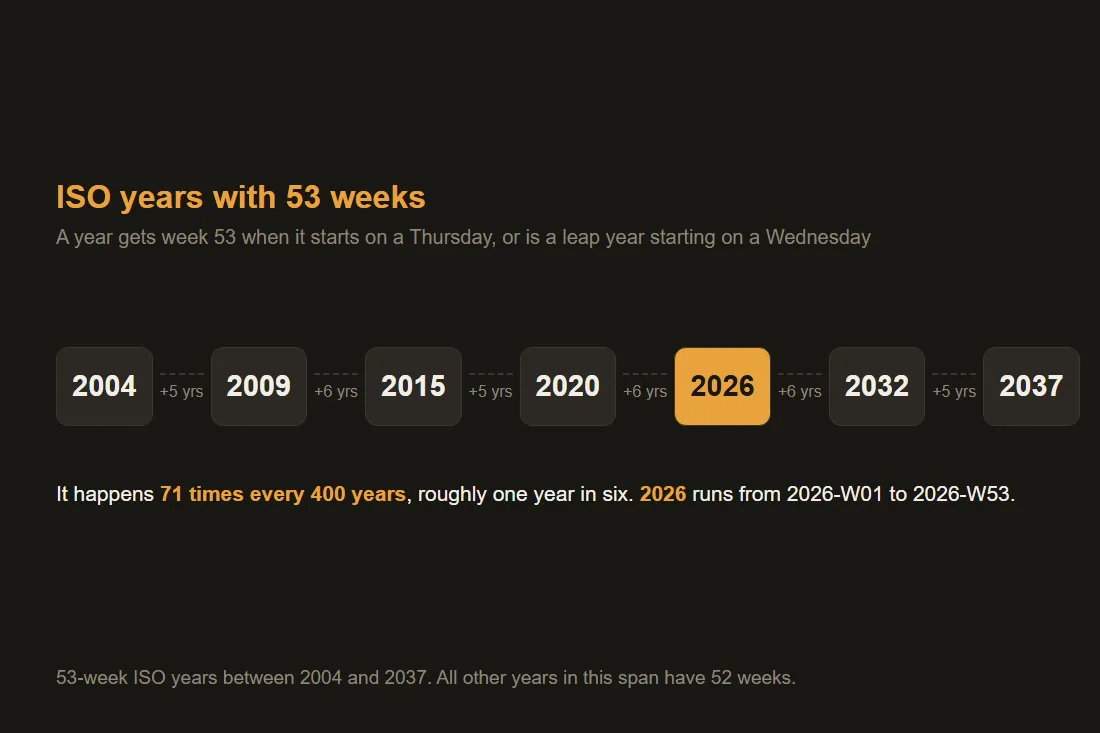
365 days divide into 52 weeks plus one day, so week counts cannot settle into a fixed rhythm. Under the ISO rules, a year gets 53 weeks when it starts on a Thursday, and also when it is a leap year that starts on a Wednesday. That happens 71 times every 400 years, roughly one year in six. 2026 is one of them: it began on a Thursday, so it runs from 2026-W01 to 2026-W53, and its last week stretches from Monday 28 December 2026 to Sunday 3 January 2027. The previous 53-week year was 2020; the next ones are 2032 and 2037. Payroll and retail planners know these years well, because an extra numbered week can mean an extra pay run or reporting period inside a budget that assumed 52.
Other systems count differently
ISO 8601 is not the only convention in use. North American calendars commonly start the week on Sunday and call the week containing 1 January week 1, whatever weekday that is; that first week can be a single day long. Spreadsheets expose both worlds: Excel's WEEKNUM function defaults to the Sunday-based count, while ISOWEEKNUM implements the ISO rule, and the two disagree for many dates. Programming languages carry the same trap inside one function: strftime alone offers %U (Sunday-based), %W (Monday-based) and %V (ISO). So "week 27" means nothing precise until you know which scheme produced it. Whenever a week number crosses a border, a company or a codebase, say ISO explicitly or attach the date range.
Looking up a week number without a wall calendar
For a date that matters, computing beats counting squares on a calendar. Our week number tool returns the ISO week for any date, with the Monday-to-Sunday range it covers; the day of week tool tells you which of the seven ISO days any date falls on, past or future. Both run entirely in your browser: the dates you type are processed on your device and never sent anywhere. And if you need a mental anchor, two are enough: 4 January is always in week 1, and 28 December is always in the last week of its year.
Tools in this article
Frequently asked questions
Why do Excel and my calendar app show different week numbers?
They almost certainly use different conventions. Excel's WEEKNUM defaults to a Sunday-start count in which the week containing 1 January is week 1; ISOWEEKNUM, most European paper diaries and calendar apps set to ISO use the Monday-start rule anchored on the first Thursday. The results can differ by one all year, and around New Year a date can be week 52 or 53 in one system and week 1 in the other. Check the week-numbering setting in each app, and prefer the ISO variant when other people need to reproduce your numbers.
Which countries actually use week numbers?
Week numbers are everyday business language in much of Europe. Germany and Austria plan by Kalenderwoche (KW), and the Nordic countries, the Netherlands and Czechia routinely schedule meetings, production runs and deliveries by week number; printed diaries there carry the ISO numbers. In North America and most of Asia, week numbers are rare outside logistics and manufacturing, and when they appear they often follow the Sunday-based count instead. That is why "delivery in week 34" is safest with an explicit date range attached.
Can there be a week 54?
Not in ISO 8601: an ISO year has exactly 52 or 53 weeks, always full Monday-to-Sunday spans. Systems that cut weeks at the year boundary can go higher. In the Sunday-start count where the week of 1 January is week 1, a leap year that starts on a Saturday spreads its 366 days over 54 partial weeks: the year 2000 was such a case, Excel's WEEKNUM returns 54 for 31 December 2000, and 2028 will be the next one. If software ever shows you week 54, you are looking at that convention, not at ISO.