Article
Calendar quarters vs fiscal years
A quarter sounds like the least ambiguous unit in business: three months, four per year. Then a US earnings report calls October to December "Q1", a British tax deadline lands on the strange date of 5 April, and a retailer's year turns out to start in February. All of these are quarters and years doing their job; they just follow different calendars. Here is how the civil quarters work, how fiscal years shift them, and how to read a "Q1" without guessing wrong.
The calendar quarters everyone agrees on
On the civil calendar the four quarters are fixed: Q1 runs 1 January to 31 March, Q2 from 1 April to 30 June, Q3 from 1 July to 30 September, and Q4 from 1 October to 31 December. The arithmetic is as simple as it looks: divide the month number by three and round up. These are the quarters behind most European VAT declarations, quarterly statistics and planning documents, and in much of continental Europe (Germany, France, Italy, Spain among others) they are the whole story, because both the state budget year and most company reporting run on the calendar year. There, Q3 2026 can only mean July, August and September of 2026.
Fiscal years start when governments decide
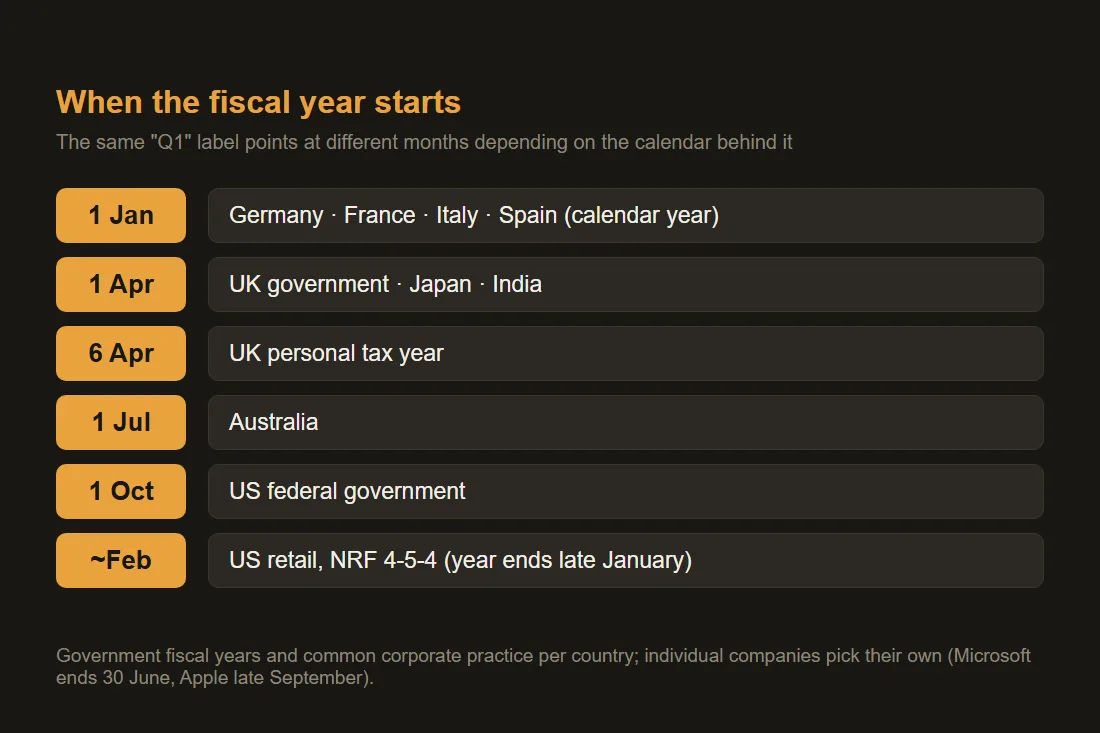
A fiscal year is an accounting year, and nothing forces it to match the calendar. The US federal government runs 1 October to 30 September. The UK government's financial year starts 1 April, while the UK personal tax year runs 6 April to 5 April. Japan and India both start on 1 April. Australia starts on 1 July. Much of continental Europe sticks to 1 January. Companies add their own layer: many simply follow the calendar, but Microsoft's fiscal year ends 30 June, Apple's ends in late September, and large US retailers close their books at the end of January so that the holiday season stays in one piece.
Fiscal quarters shift with the year start
Once the year start moves, the quarter labels move with it. The US federal FY2026 began on 1 October 2025, because federal fiscal years are named after the calendar year in which they end; its Q1 is October to December 2025. Apple's fiscal year works the same way, which is why Apple announces "first quarter" results in late January that cover the Christmas season. So a bare "Q1 2026" is genuinely ambiguous: on the civil calendar it means January to March, in a US federal context October to December 2025, at Microsoft July to September 2025. The reading rule: find out when the fiscal year ends, count quarters from its start, and expect the year label to name the end year.
The retail exception: the 4-5-4 calendar
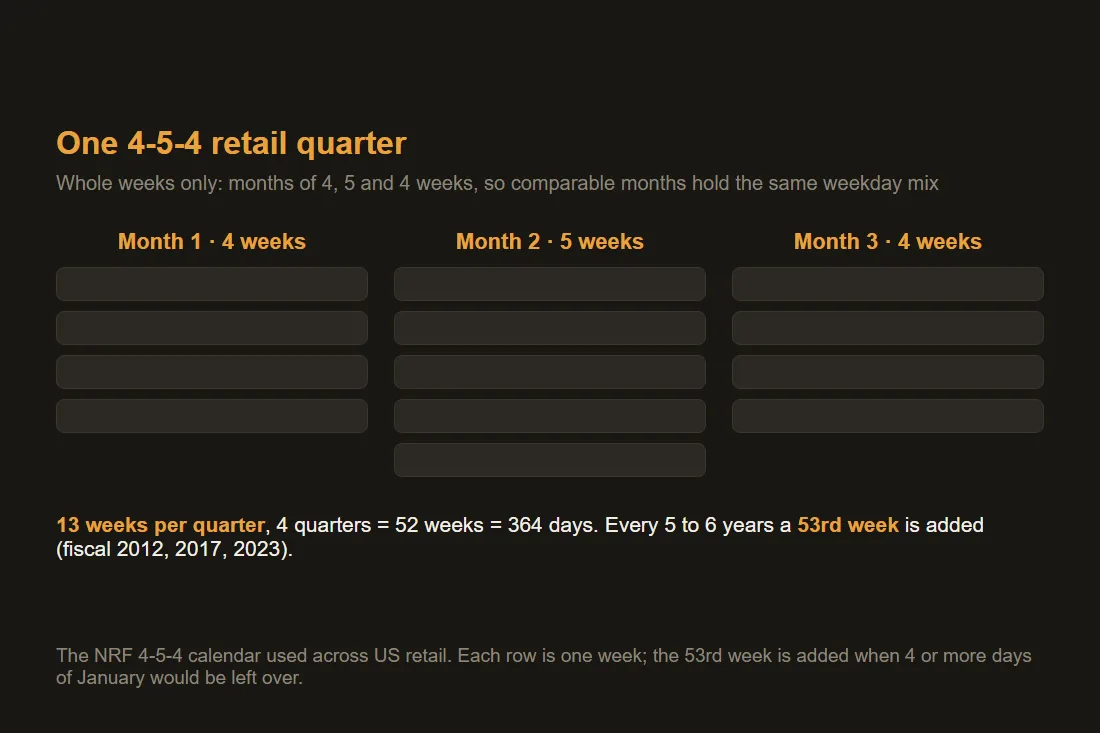
Retailers have a further problem: months contain different numbers of weekends, and for a shop a Saturday is not a Tuesday. The 4-5-4 calendar, maintained by the National Retail Federation, fixes that by building each quarter from whole weeks in a 4-week, 5-week, 4-week pattern: 13 weeks per quarter, 52 weeks per year, and every month in a like position contains the same number of each weekday, so sales compare cleanly year over year. The catch is familiar from week numbering: 52 weeks are only 364 days, so roughly every five to six years the calendar inserts a 53rd week (the NRF adds it when four or more days of January would otherwise be left over; fiscal 2012, 2017 and 2023 were such years). The retail year starts near the beginning of February, which is why Walmart's fiscal year ends on 31 January.
Finding the quarter of any date
For civil quarters, no lookup is really needed: month 1 to 3 is Q1, 4 to 6 is Q2, 7 to 9 is Q3, 10 to 12 is Q4. Our quarter tool does the division for you and returns the exact start and end dates of the quarter a date belongs to, which is handy for deadlines set as "end of the quarter"; the date details tool goes further and shows a date's quarter next to its ISO week number, weekday and day of the year. Both run entirely in your browser, and nothing you type leaves your device. For fiscal quarters, remember there is no shortcut: you need to know whose fiscal calendar you are in before the label Q1 means anything at all.
Tools in this article
Frequently asked questions
Is Q1 always January to March?
On the civil calendar, yes: Q1 is January, February and March by definition. In fiscal contexts, Q1 is simply the first quarter of whatever year the organization runs. The US federal Q1 is October to December, Apple's Q1 covers roughly October to December too, Microsoft's is July to September, and a Japanese company's Q1 is April to June. When a headline says a company "beat expectations in Q1", the months behind that label depend entirely on the company's fiscal calendar.
Why does the US government's FY2026 start in 2025?
Because US federal fiscal years are named after the calendar year in which they end. FY2026 runs from 1 October 2025 to 30 September 2026: nine of its twelve months lie in 2026, so the label follows the end. Australia often writes the same idea explicitly as a split label, 2025-26, for its July-to-June year. When you read budget figures, check whether the source names years by their start or their end before comparing anything.
Why does the UK tax year start on 6 April?
It is a fossil of the 1752 calendar reform. The English year traditionally started on Lady Day, 25 March, and so did the tax year. When Great Britain switched to the Gregorian calendar in 1752 and skipped 11 days, the Treasury refused to shorten the tax year and collect a full year's tax on fewer days, so the year end slid to 4 April, making 5 April the new start; a further one-day adjustment in 1800 moved it to 6 April, where it has stayed. The UK government's own financial year, by contrast, uses a plain 1 April start.