Article
Counting business days between two dates
"Add 30 business days" sounds simple until you realize that holidays differ by country, that the weekend is not always Saturday and Sunday, and that most calculators disagree on whether to count the start date. This article explains the mechanics so you know what you are actually computing.
What a business day is
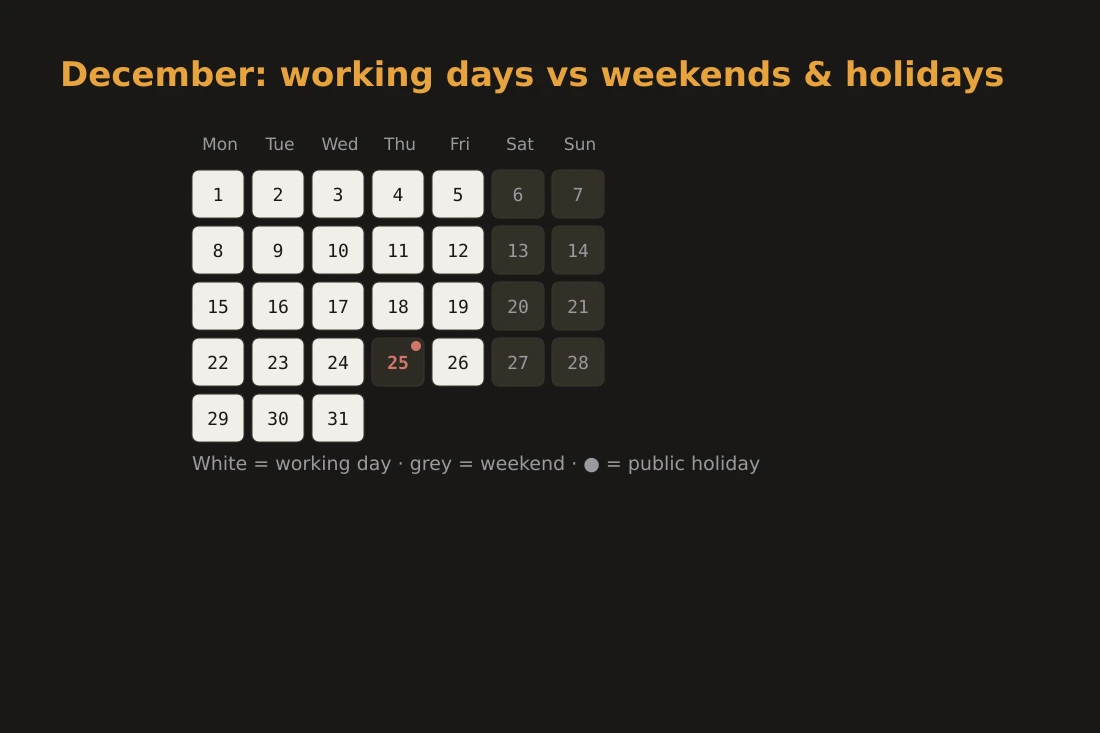
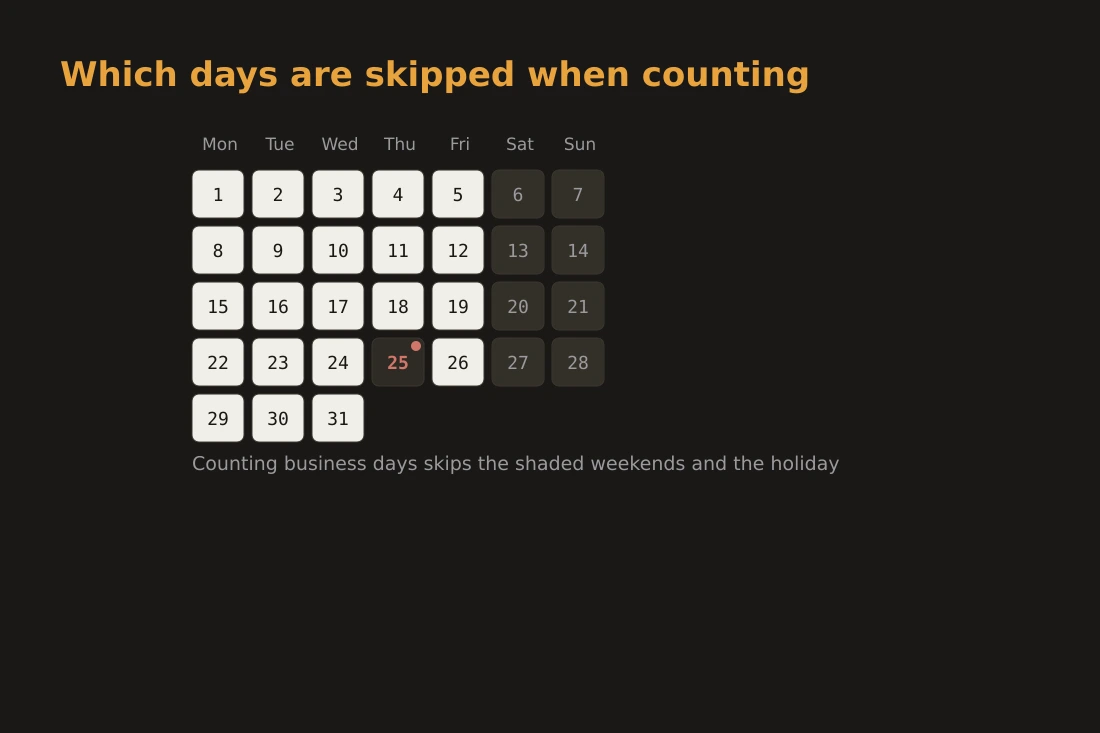
A business day is any day that is not a weekend day and not a public holiday. In most countries that means Monday through Friday, minus the official public holidays recognized by that country's labor law or banking system. The gap between a calendar day count and a business day count grows quickly: a 30-calendar-day span crossing Christmas and New Year in France contains only about 20 business days once weekends and the relevant public holidays are removed. Note that the weekend definition itself varies: in some Gulf states the working week runs Sunday through Thursday, making Friday and Saturday the weekend. The definition matters most at the boundaries: if a deadline falls on a Saturday, the effective deadline is usually the preceding Friday or the following Monday depending on the contract or the jurisdiction. Neither answer is wrong in isolation; what matters is that both parties use the same rule.
Inclusive vs. exclusive counting and the off-by-one trap
The most common source of disagreement between two people counting the same interval is whether the start date and the end date are counted. Inclusive counting treats both endpoints as part of the span. Exclusive counting ignores one or both endpoints. A contract that says "deliver within 5 business days of the order date" is ambiguous: does day zero mean the order date, so that delivery is due at the close of day 5, or does the count start the next working day? In practice, payment and shipping terms in commercial law typically exclude the start date and include the end date, making the span open-open or half-open rather than fully inclusive. The safest approach when the wording is unclear is to ask and to document the answer, then verify your count using a tool that explicitly states which convention it applies. The business-days calculator on this site counts the inclusive range by default: both the start and end dates are included in the tally.
Fixed holidays, movable feasts, and the regional problem
Public holidays divide into two categories. Fixed-date holidays fall on the same calendar date every year: January 1, July 4, December 25. Movable holidays change each year because they are anchored to a lunar or ecclesiastical cycle: Easter and the derived feasts (Easter Monday, Ascension, Whit Monday) shift by up to five weeks depending on the year. The bigger challenge for any calculator is regional coverage. Germany has a federal set of nine holidays plus two to five additional ones that vary by state. Spain has a national list plus autonomous community days. The United States has federal holidays but no national rule requiring private employers to observe them. The business-days tool on this site covers the main national holidays for France, the United States, the United Kingdom, Germany, Spain, Italy, Canada, and Belgium. Regional holidays are not included. If your contract or SLA names a specific state or province, check the result against an authoritative local source.
Practical uses: payment terms, SLA deadlines, notice periods
The most common real-world use of business-day counting is payment terms. "Net-30" means payment is due 30 calendar days after the invoice date, but some contracts write "net-30 business days", which adds several weeks to the window. Knowing the difference before you sign matters. Shipping and logistics SLAs usually quote business days because carriers do not operate on weekends or public holidays; a "5-business-day delivery" from a Friday order will typically arrive the following Friday at the earliest. Employment law often specifies notice periods in working days: a resignation requiring ten working days' notice given on a Monday is effective two calendar weeks later if no holidays intervene, but that shifts if a public holiday falls in the window. Landlord-tenant law, legal summons deadlines, and financial settlement cycles (T+1, T+2) all operate on business-day logic. The date-difference tool on this site lets you compare total days and calendar weeks as a cross-check against the business-day figure.
Doing it in the browser without sending data anywhere
The business-days calculator and the date-difference tool on this site run entirely in the browser. You enter two dates, pick an optional country for national holidays, and the result is computed locally using JavaScript. No date, no date range, and no country selection is sent to any server. The holiday logic is compiled into the page at build time: the French, German, or US holiday sets for a given year are computed on the fly from a small algorithm rather than fetched from a remote database. Because movable feasts are calculated rather than stored, the tool works for past years and future years within reasonable range without needing a network connection. The trade-off is the one described in the previous section: the holiday list is a curated national-level set, not a comprehensive local one. Use the result as a reliable starting point, then check regional specifics when precision is required.
Tools in this article
Frequently asked questions
Does net-30 mean 30 calendar days or 30 business days?
In most standard commercial usage, net-30 means 30 calendar days. If a contract intends business days it will usually say so explicitly. When in doubt, check the contract wording; the gap between the two interpretations can be several weeks.
Why does the tool not cover all regional holidays?
The business-days tool includes main national public holidays for eight countries. Regional holidays (US states, German Laender, Spanish autonomous communities) are not included because they vary at the sub-national level and a national-level tool cannot reliably generalize them. The tool documents this limitation so you can apply local corrections.
Is the start date counted or not?
The business-days calculator on this site uses an inclusive range by default: both the start date and the end date are included in the count. Many contracts and legal frameworks exclude the start date (the event day does not count as day one). If your context excludes day zero, subtract one from the result.