Article
How race timing works: stopwatch vs chip timing
Pressing start on a stopwatch tells you how long you ran. It cannot tell you when five thousand people each crossed a start line that took four minutes to clear. Race timing solves a different problem, and it does it with a small radio chip.
What a stopwatch actually measures
A stopwatch measures elapsed time between the moment you press start and the moment you press stop. Add a lap button and it also records split times: each press marks a point without stopping the clock, so you can see how long each kilometre, length or interval took. That is exactly what you want for a solo run, a swim set or a timed workout. The Sunasty stopwatch runs in the browser, keeps your laps in a list, and never sends anything anywhere. Its limit is structural: it measures one clock, started and stopped by one person. A race has to measure thousands of clocks at once, and nobody is pressing a button for each runner.
Gun time versus chip time
When a large field starts together, the people at the back can take several minutes just to reach the line after the gun fires. If everyone were scored from the gun, those runners would be penalised for standing in a crowd. This is why races report two times. Gun time, also called official time, runs from the starting signal to the finish, the same start instant for everyone. Chip time, also called net time, runs from the moment you personally cross the start mat to the moment you cross the finish mat. For most runners, chip time is the fair measure of effort. Placings at the front of elite fields are usually scored on gun time, because there everyone starts on the line together and head-to-head order is what counts. Knowing which one a result uses explains most of the confusion about why two times differ.
Transponders and antenna mats
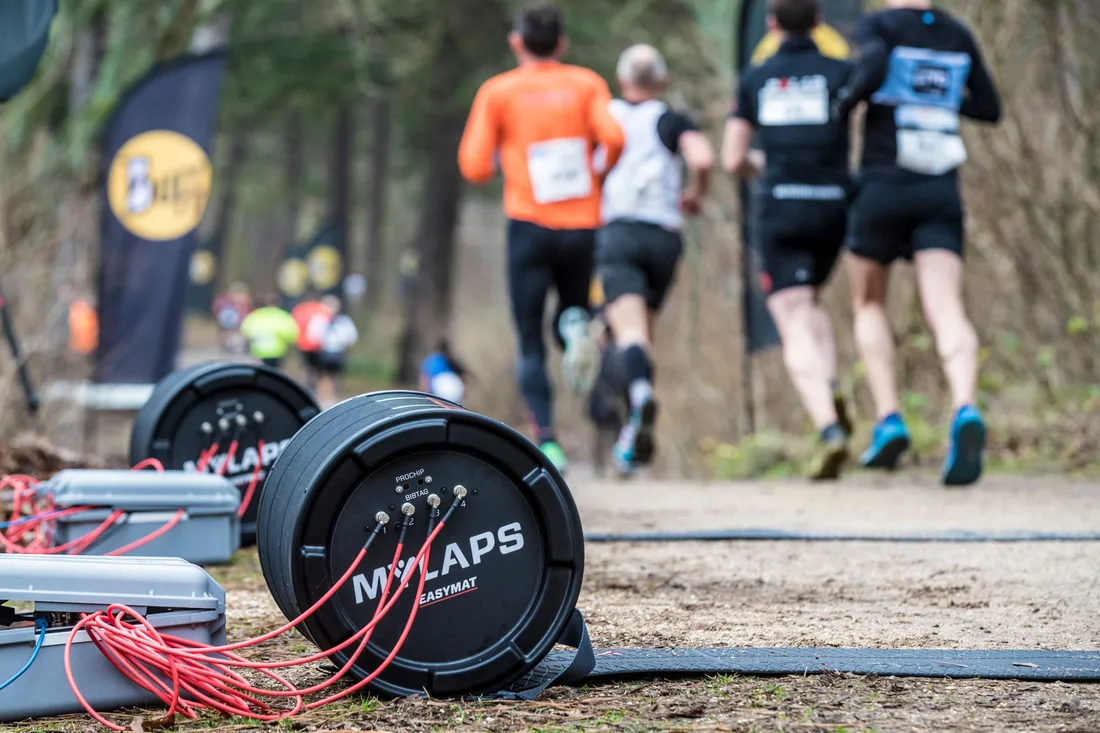
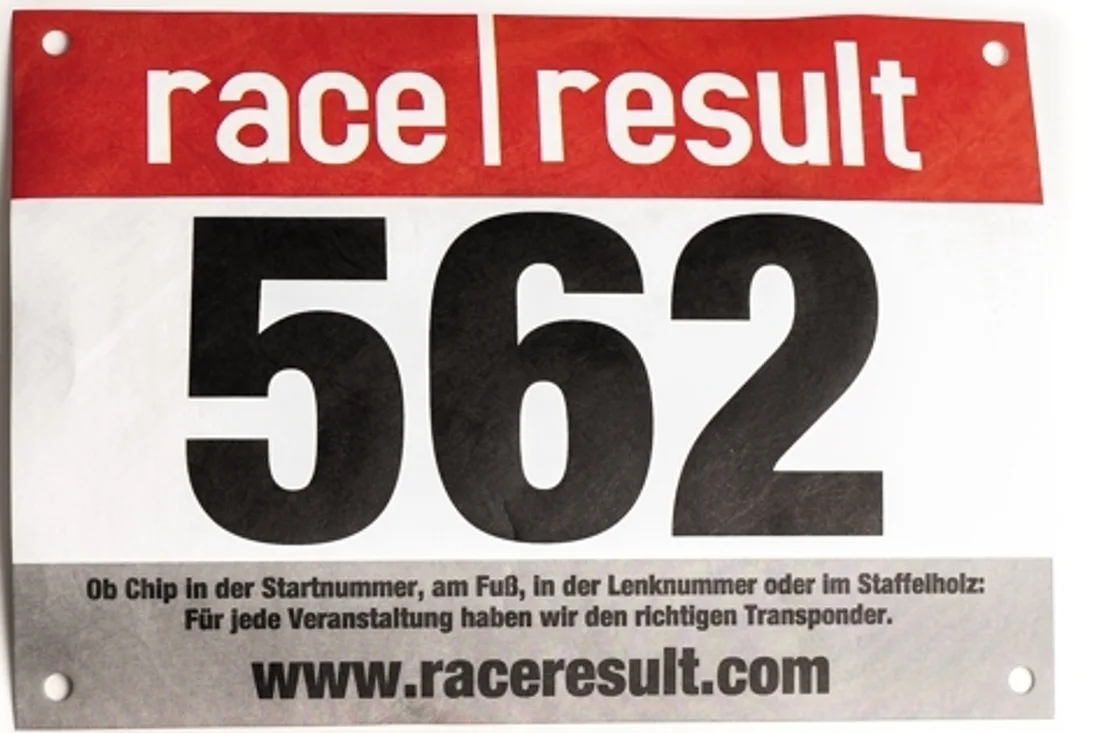
A race transponder is a small RFID tag carried by each participant, usually built into the bib number or strapped to an ankle. At the start, the finish and any intermediate split, the organiser lays antenna mats across the full width of the course. Each mat creates a radio field. When a transponder passes over it, the tag's unique ID is read, stamped with the exact time, and matched to the runner in the entry database. Because the read is automatic, a single mat can record hundreds of runners crossing within the same few seconds without anyone touching a button. Intermediate mats produce the split times you see on live trackers, and they double as a fairness check: a finisher with no record at the halfway mat clearly missed part of the course.
Passive and active chips
Transponders come in two families. A passive tag has no battery. It is powered by the energy of the reader's radio field for the instant it crosses the mat, which makes it cheap enough to be disposable and printed straight onto the back of a bib. Most road races use passive UHF tags for this reason. An active tag carries its own battery and broadcasts continuously, which gives a longer and more dependable read range and better accuracy in dense packs or at high speed, at the cost of being reusable hardware that has to be collected and recharged. The choice is a trade-off between cost and read reliability, not a question of one being modern and the other outdated. Both are in everyday use.
Different races, different timing needs
A city marathon relies on passive chip time and a chain of split mats, so tens of thousands of runners each get a personal net time and a live position. A triathlon adds a twist: the clock keeps running through the swim-to-bike and bike-to-run transitions, so the transponder, worn on the ankle where it survives water and a wetsuit, records entry and exit at each transition area as well as the finish. Short, fast events push timing the other way. In a track sprint or a cycling bunch finish, hundredths of a second separate places and bodies cross almost together, so organisers add a photo-finish line-scan camera as the deciding instrument and keep the transponder for backup and identification. The faster and tighter the finish, the more the timing system has to resolve.
What you can time yourself, locally
You will not lay an antenna mat across your driveway, but most of what a runner needs day to day is plain stopwatch work. Use the stopwatch with its lap button to record interval splits or lengths in a pool. Use a countdown timer for fixed work and rest blocks. If you are training for a distance, a pace calculator turns a target finish time into the per-kilometre or per-mile pace you need to hold, which is the number you actually check on your watch during the race. All three run entirely in your browser, with nothing uploaded. The race-day chip handles the official result; these handle the preparation.
Tools in this article
- Online stopwatchA precise stopwatch with laps. No signup, runs entirely in your browser.
- Countdown timerCount down to any date and time, with a shareable link. Live, private, in-browser.
- Running Pace CalculatorCalculate your running pace, time or distance instantly in your browser - no upload, 100% private.
Frequently asked questions
Why is my chip time different from the official time?
Official, or gun, time counts from the starting signal, which fires once for the whole field. Chip, or net, time counts from the moment you personally crossed the start mat. In a big race it can take minutes to reach the line after the gun, so your chip time is shorter. Most results show both, and your net time is the one that reflects your actual running.
Do I have to give the chip back after the race?
It depends on the type. Disposable passive tags printed into the bib are yours to keep or recycle. Reusable transponders, often the ankle-strap kind used in triathlons and smaller events, are collected at the finish because they contain a battery and electronics worth reusing. The race instructions tell you which kind you have.
Can I just use my phone or GPS watch instead?
For your own training and a personal record, yes: a GPS watch or a stopwatch gives you elapsed time and splits. It cannot give you an official race result, because that needs every runner read at the same fixed mats and matched to the entry list. Your watch times you; the race system times everyone at once, fairly and comparably.