Article
Marathon pace and race planning: a practical guide
Getting your pacing right is the single biggest controllable factor on race day. This guide covers the units, the math, and a few physiological realities that shape how a marathon unfolds. All the calculations can be done with the pace-calculator tool, which runs entirely in your browser.
Pace vs speed: the units
Pace and speed describe the same thing from opposite directions. Speed (km/h or mph) tells you how far you travel in a fixed time. Pace (min/km or min/mile) tells you how long it takes to cover a fixed distance. Most runners in metric countries think in min/km; those in the US and UK often default to min/mile. Converting between them is straightforward. A pace of 5:00 min/km equals 12 km/h, because 60 divided by 5 gives 12. In min/mile, the same effort converts to roughly 8:03 per mile (5:00 multiplied by 1.60934). Going the other way: 10 km/h equals 6:00 min/km. Why does it matter? Race clocks, GPS watches, and course signs can mix units. Knowing how to convert on the fly prevents you from misreading your effort and going out at the wrong pace. The pace-calculator handles all three units so you can cross-check without mental arithmetic.
Splits: reading the race in segments
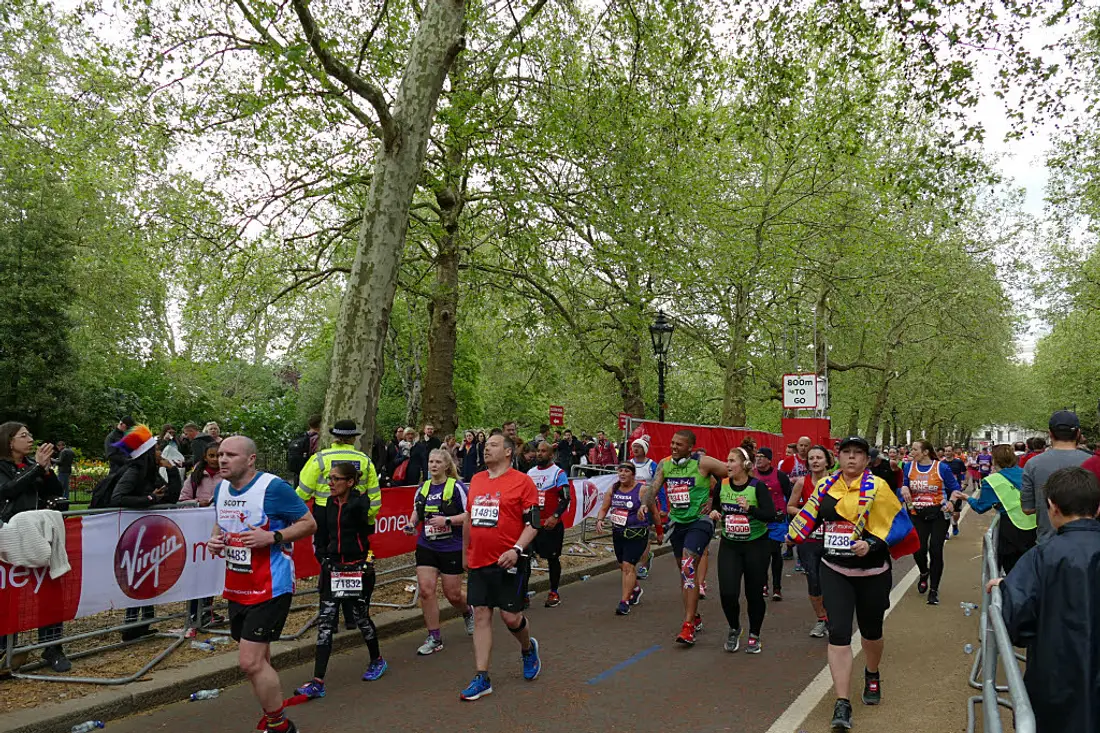
A split is simply your time for a defined portion of the course, most commonly each 5 km or each mile. Your total finish time equals your average pace multiplied by the full distance. At 5:30 min/km over 42.195 km, that works out to 3:52:04. Even splits mean running each segment in the same time. Negative splits mean the second half is faster than the first. Positive splits mean the second half is slower, which is what happens to most runners who go out too fast. The physiological reason for this is straightforward: glycogen depletion and neuromuscular fatigue both accelerate in the back half. Starting 10 or 15 seconds per km faster than your target feels comfortable for the first 20 km, but that surplus burns fuel faster and often results in a much slower final third. Most personal records are set with even or slightly negative splits. The first half should feel almost too easy.
Predicting your finish time: the Riegel formula
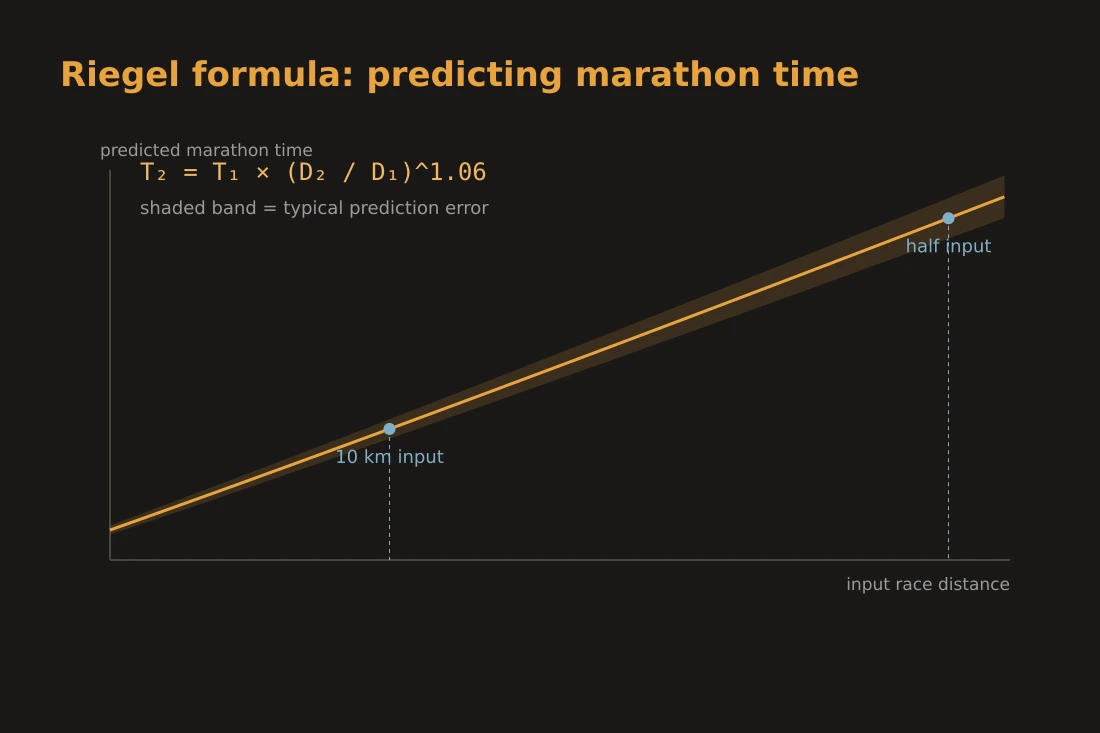
If you have a recent race result at a shorter distance, the Riegel formula gives a rough marathon prediction. The formula is T2 = T1 x (D2 / D1)^1.06, where T1 is your known time over distance D1, and T2 is the predicted time over target distance D2. The exponent 1.06 reflects that performance degrades slightly as distance increases. For example, a half-marathon in 1:50:00 predicts a marathon around 3:49:45. A 10 km in 50:00 predicts roughly 3:50:00. The formula has real limits. It assumes your training is specifically adapted to the marathon distance, that the two races happened in comparable conditions (weather, elevation, fatigue level), and that the shorter race was run close to full effort. A half-marathon is generally a more reliable predictor than a 10 km, because the physiological profile is closer. Treat the result as a planning anchor, not a guarantee. Training quality, taper execution, and race-day weather can each shift the outcome by several minutes.
Race-day planning: pace bands and the 30 km wall
A pace band is a card or wristband listing your target split time at each marker. Preparing one before the race reduces cognitive load and helps you spot drift early. Set a target pace, then add a small tolerance band (for example, plus or minus 10 seconds per km) rather than chasing a single number through variable terrain and weather. The 30 km point deserves particular attention. Glycogen stores in the muscles are roughly sufficient for 30 km at marathon effort. Beyond that point, the body shifts toward fat oxidation and the muscles become progressively less responsive. Many runners experience a sharp drop in pace between 30 and 35 km even when the first half felt controlled. This is the wall. The main practical countermeasure is fueling early. General guidance (not medical advice) suggests taking carbohydrate from around 45 minutes in, at intervals of 30 to 45 minutes, without waiting to feel depleted. Hydration needs vary by temperature and sweat rate. Practice your fueling plan in long training runs first.
Doing the math locally with the pace-calculator
The pace-calculator on this site runs entirely in your browser. You can convert between pace and speed, calculate a finish time from a target pace, or work backward from a goal time to a per-km pace. It does not automate the Riegel prediction described above; work that formula out by hand from a recent race result, then enter the predicted time as your target to build the rest of your pace plan. Because everything runs client-side, your training data, race times, and personal targets are never sent to any server. Nothing leaves your device. This is the same privacy guarantee that applies to every tool on sunasty.com. To build a pace band, calculate your target split for each 5 km segment, print or write them down, and attach them to your wrist or race number. Some runners also prepare a conservative fallback pace, typically 10 to 15 seconds per km slower than the target, to activate if they reach 30 km behind schedule.
Tools in this article
Frequently asked questions
Is the Riegel formula accurate for marathon prediction?
It is a reasonable planning estimate when based on a recent half-marathon run close to full effort in comparable conditions. The formula tends to be optimistic if your longest training run was significantly shorter than the marathon, or if the predictor race was run in cooler or flatter conditions than race day. Treat the output as a starting point for target pace selection, not a fixed prediction.
Why is running even splits harder than it sounds?
Early in a race the legs feel fresh, crowds provide momentum, and adrenaline inflates perceived effort. Many runners cover the first 5 km 20 to 30 seconds per km faster than their target without realizing it. GPS watches can drift under tree cover or tall buildings, adding to the confusion. Reviewing splits at each 5 km marker and consciously slowing down in the first third is the most reliable corrective.
Does the tool store any of my race data?
No. The pace-calculator runs entirely in your browser and performs all calculations locally. No data is transmitted to a server and nothing is stored beyond your current session. Closing the tab clears everything.