Article
Macros, calories and body fat: what the numbers mean and how accurate they are
Calorie targets, macro splits and body fat percentages are useful reference points, not fixed facts. Every formula covered here is a population-level estimate with real error bars. This article explains what the numbers mean, how they are calculated, and where they fall short, so you can use them as one input among many rather than as a precise prescription.
BMR and TDEE: your calorie baseline
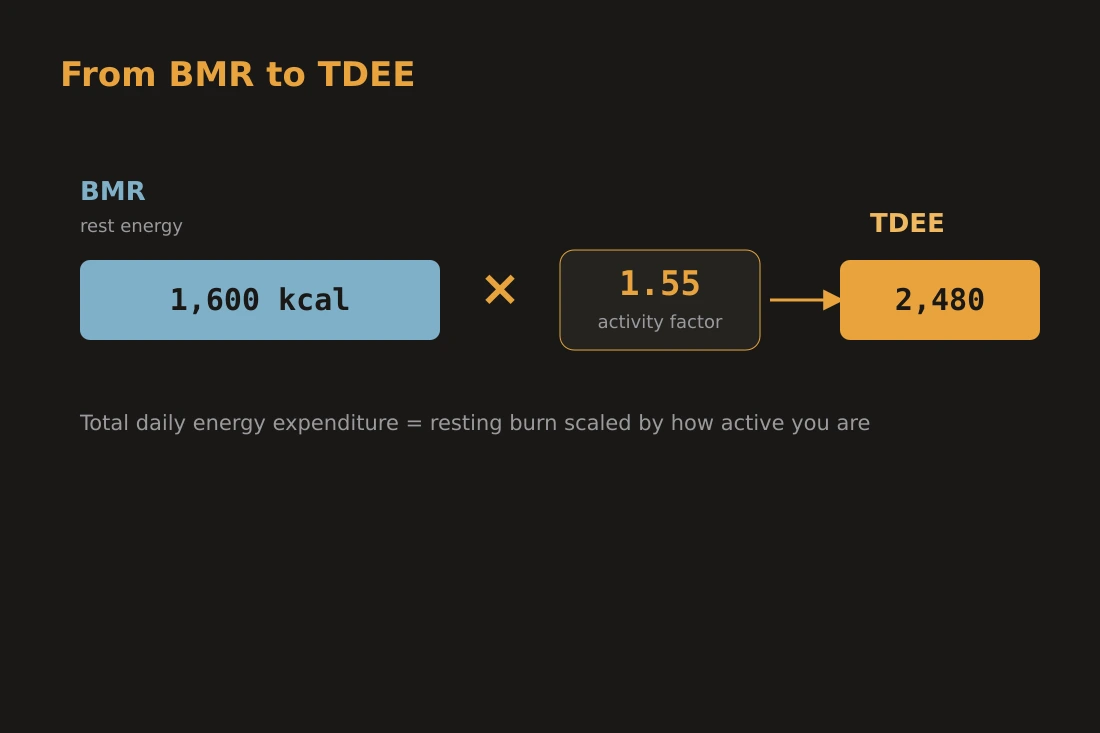
Basal metabolic rate (BMR) is the number of calories your body burns at complete rest to keep basic functions running: breathing, circulation, cell repair. It represents roughly 60 to 70 percent of total daily energy expenditure for most sedentary adults. Total daily energy expenditure (TDEE) adds the calories burned through activity and digestion on top of BMR. The most widely cited formula for estimating BMR is Mifflin-St Jeor, published in 1990. For men: BMR = (10 x weight in kg) + (6.25 x height in cm) - (5 x age in years) + 5. For women: same calculation but the constant is -161 instead of +5. TDEE multiplies the result by an activity factor, typically 1.2 for sedentary, 1.375 for lightly active, up to 1.9 for very hard training. Published validation studies find that Mifflin-St Jeor estimates measured resting metabolic rate within about 10 percent for roughly 80 percent of subjects. The remaining 20 percent fall outside that window, sometimes by a wide margin. Individual metabolic rate depends on genetics, hormonal status, body composition, and prior dieting history in ways no formula can fully capture.
Macros: what protein, carbs and fat actually provide
Macronutrients are the three classes of food that supply calories: protein provides 4 kcal per gram, carbohydrates provide 4 kcal per gram, and fat provides 9 kcal per gram. A macro split expresses what proportion of total daily calories each of the three contributes. A common moderate split is 30 percent protein, 40 percent carbohydrates and 30 percent fat, though the appropriate proportions vary by goal, health status and food preference. To convert a split into grams: multiply total daily calories by the percentage share, then divide by the relevant kcal-per-gram figure. For example, on a 2000 kcal target with 30 percent protein, protein grams = (2000 x 0.30) / 4 = 150 g. The 4/4/9 values are averages for mixed food; actual caloric yield varies slightly by food source and by individual digestion efficiency. Dietary fiber is a carbohydrate but contributes closer to 2 kcal per gram for most people, so high-fiber diets yield slightly fewer calories than the standard formula predicts.
Body fat estimation: methods and their limits
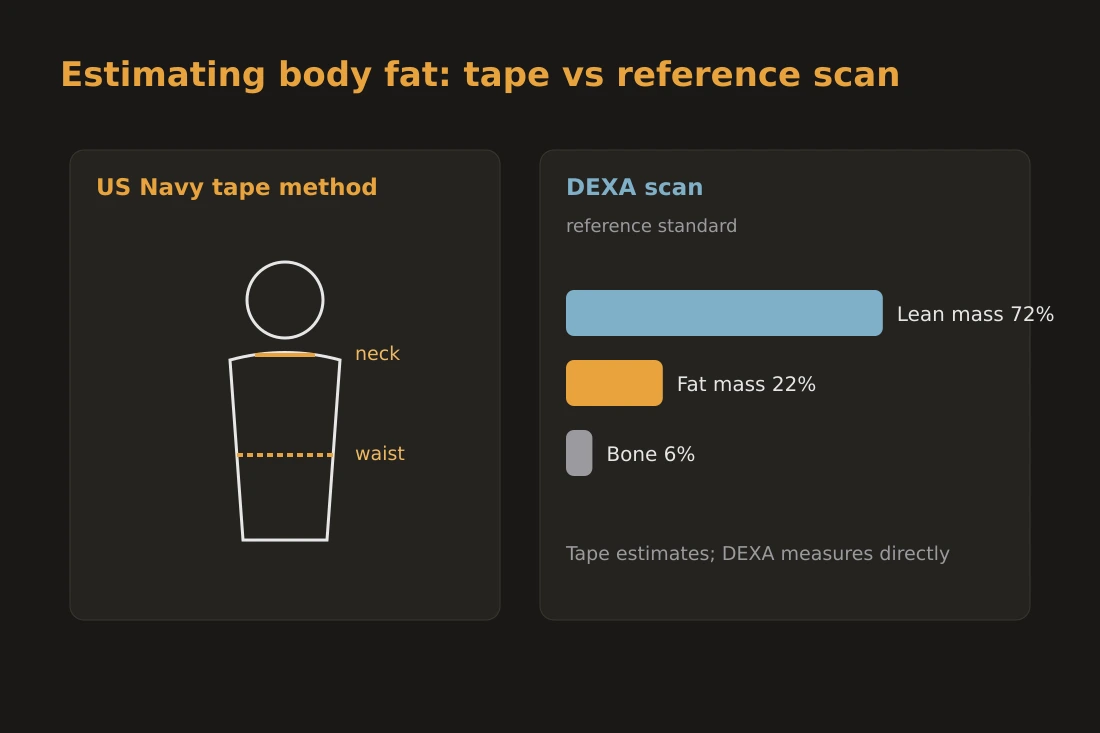
Body fat percentage describes the fraction of total mass that is adipose tissue. Several methods exist, with very different accuracy levels. DEXA scan (dual-energy X-ray absorptiometry) is the reference standard in research, with an error of roughly 1 to 2 percentage points, but requires specialist equipment. The US Navy circumference method, developed in the 1980s, estimates body fat from waist, neck, and hip measurements combined with height. It uses logarithmic formulas and typically falls within 3 to 4 percentage points of DEXA for average adults, though error increases at the extremes of body composition. BMI (body mass index, calculated as weight divided by height squared) is often discussed alongside body fat but is not a body fat measurement. BMI correlates with population-level disease risk but does not distinguish fat from muscle, bone density differences, or fluid. A muscular person can have a high BMI with low body fat; an older person with low muscle mass can have a normal BMI with high body fat. Using BMI as a proxy for individual body fat percentage produces large errors and is not recommended for that purpose.
Using these estimates responsibly
All of the numbers discussed here are estimates derived from population studies, and their confidence intervals are wide. A TDEE formula can be off by 200 to 400 kcal per day for a given individual. A circumference-based body fat estimate can be off by 3 to 5 percentage points in either direction. The Mifflin-St Jeor equation was built from data on healthy adults and may be less accurate for people with metabolic conditions, very low or very high body fat, or significant hormonal variation. These limitations do not make the tools useless, but they do mean that a single number should not drive hard decisions about nutrition or health. Track changes over time rather than placing confidence in any single measurement. If you have a medical condition, are taking medication that affects metabolism, or are considering significant changes to diet or training, the right starting point is a registered dietitian or a physician, not a formula. Nothing in this article is medical advice.
Running the calculations locally
The calorie-calculator on Sunasty computes BMR using Mifflin-St Jeor and applies your chosen activity multiplier to produce a TDEE estimate. The body-fat-calculator applies the US Navy circumference formula to your tape measurements. Both tools run entirely in your browser using JavaScript. No measurements, no inputs, and no results are sent to any server. The page loads the formula and does the arithmetic locally; your weight, height, waist and hip figures stay on your device. This is the same privacy guarantee that applies to every tool on the site: your data does not leave your device, ever. The output of each tool is a starting estimate. Use it as a rough benchmark, adjust based on real-world results over several weeks, and treat any number that differs substantially from how you actually feel or perform as a prompt to investigate further.
Tools in this article
- Calorie CalculatorCalculate your BMR and TDEE to find daily calorie needs for weight loss, maintenance, or gain, 100% private, no upload.
- Body Fat & Ideal Weight CalculatorEstimate your body fat percentage and ideal weight instantly, US Navy method, 100% offline, no data leaves your device.
- Unit converterConvert length, mass, temperature, volume, area, speed, data and time units. No upload.
- BMI CalculatorCalculate your Body Mass Index instantly, no upload, no server, 100% private.
- Age calculatorWork out an exact age in years, months and days from a birth date, 100% in your browser.
Frequently asked questions
How accurate is Mifflin-St Jeor for estimating my calorie needs?
Studies find it estimates measured resting metabolic rate within about 10 percent for roughly 80 percent of subjects. For the remaining 20 percent, the error can be larger. The activity multiplier adds further uncertainty. Treat the TDEE output as a starting point and adjust by 100 to 200 kcal increments based on actual weight changes over two to four weeks.
Is BMI a good way to estimate body fat?
No. BMI uses only weight and height and cannot distinguish fat from muscle or account for differences in bone density. Two people with identical BMI values can have very different body fat percentages. BMI correlates with population-level health risk, but using it to estimate an individual's body fat percentage produces unreliable results.
Does the calorie or body fat calculator upload my measurements?
No. Both the calorie-calculator and the body-fat-calculator run entirely in your browser. The arithmetic is done locally in JavaScript, and none of your inputs leave your device. There is no account, no server, and no data transmission.