Article
Is a drawn signature on a PDF legally valid?
Drag your mouse to sketch a signature, drop it onto a PDF, and the document looks signed. Whether that holds up depends on what you mean by "signed": a handwriting-style mark on a page and a cryptographically generated signature are both called electronic signatures, but they prove completely different things. This is a general explanation of the distinction, not legal advice for any specific country or document, since the rules vary by jurisdiction and by what you are signing.
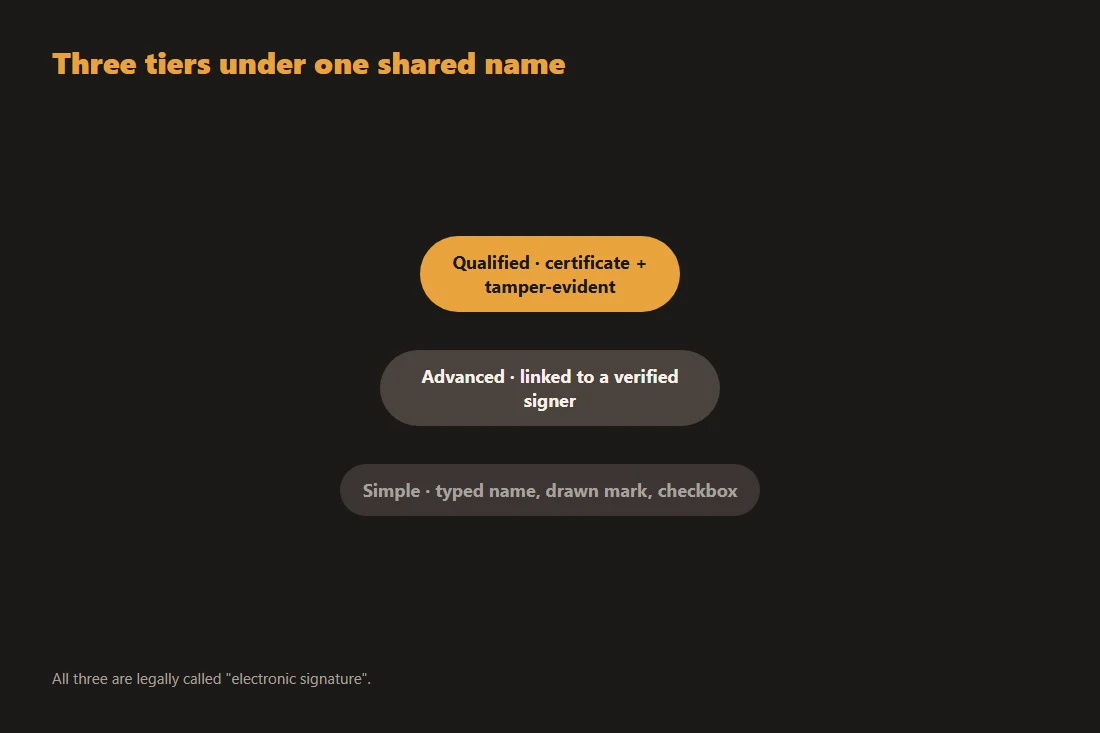
Three tiers, one shared name
Regulations tend to describe electronic signatures in tiers. A simple electronic signature is any data attached to a document that shows intent to sign: a typed name, a scanned wet-ink signature, a drawn scribble, even a checkbox ticked before submitting. An advanced electronic signature adds a link to a specific signer, usually through an account or a verified identifier. A qualified electronic signature goes further still: it is generated with a certificate issued by an accredited provider and is bound cryptographically to the exact bytes of the file, so any later change to the document is detectable.
What a drawn signature actually proves
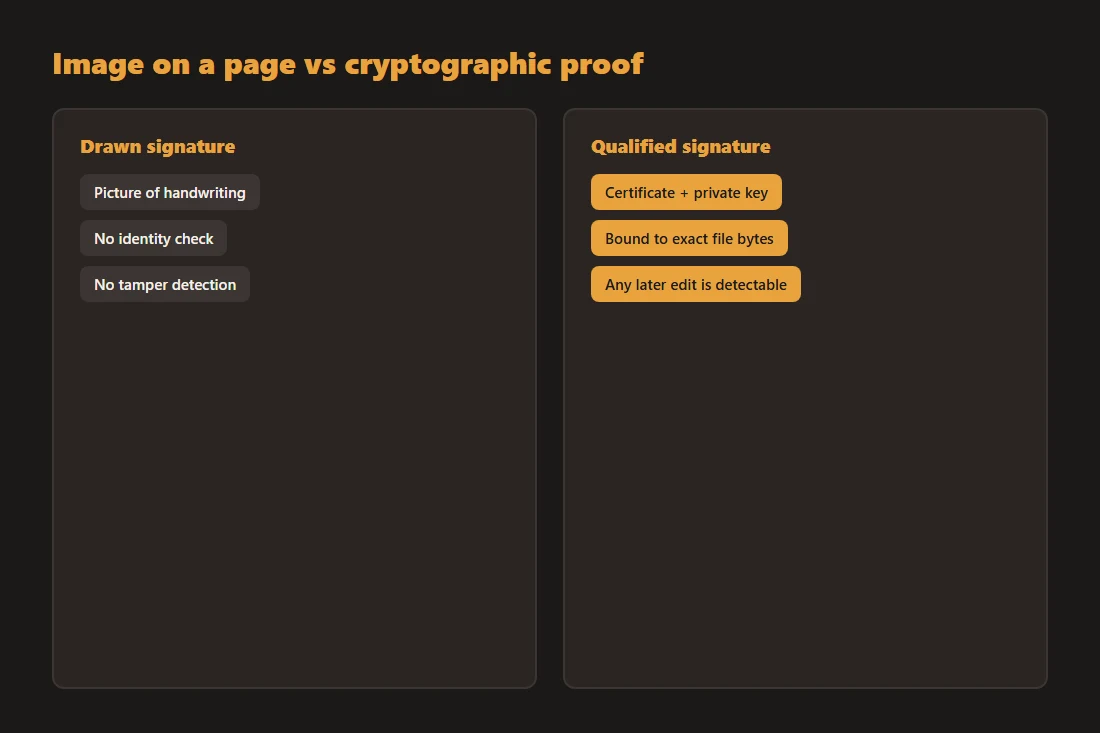
A signature drawn with a mouse or a finger and stamped onto a PDF sits in the "simple" tier. It approximates the look of your handwriting, and it shows you took the deliberate step of placing it there. It does not cryptographically bind you to that specific document: the image itself carries no verified identity and no tamper detection, so the same picture could in principle be placed on a different file by anyone who has it. It is a mark of intent, not mathematical proof of who signed or that nothing changed afterward.
Where a simple signature is usually enough
Many everyday contracts do not require anything more than a simple electronic signature. Frameworks like the US ESIGN Act and the EU's eIDAS regulation both recognize a simple electronic signature as legally valid for most agreements, as long as both parties intended to be bound and can be identified if the agreement is later disputed. In practice that covers a large share of freelance contracts, internal approvals, quotes and everyday paperwork exchanged between people who already trust each other.
Where it is usually not enough
Some documents are carved out for a higher bar: notarized deeds, wills, certain government filings, and some cross-border or high-value contracts often require a qualified electronic signature, or a physical wet-ink signature witnessed in person, depending on the country. Under eIDAS, only a qualified electronic signature carries the same automatic legal weight across the EU as a handwritten one; a simple signature can still be admitted as evidence, but a court decides case by case whether it is sufficient, rather than it being guaranteed in advance.
Checking before you rely on one
A tool like pdf-sign draws a visual signature stamp onto a PDF locally in your browser; it does not generate a cryptographic PAdES signature or a certificate tied to your identity. That makes it a reasonable fit for informal approvals, drafts and everyday contracts where a simple electronic signature is accepted. For anything where the counterpart, an institution, or a specific law requires a qualified or notarized signature, check that requirement first rather than assuming a drawn mark will satisfy it.
Tools in this article
Frequently asked questions
Is a drawn or scanned signature the same thing as a digital signature?
No. A drawn signature is an image placed on the page; a digital signature in the strict, cryptographic sense is generated with a private key, mathematically tied to the exact document content, and can prove the file was not altered after signing. Both can be called an electronic signature, which is why the terms get confused.
Can I use a tool like pdf-sign for a legally binding contract?
For many everyday agreements where a simple electronic signature is legally accepted, yes, as long as both sides intend to be bound and can be identified later. For notarized documents, wills, some government filings, or contracts that specifically require a qualified or advanced electronic signature, a drawn stamp will not meet that bar. Check the specific requirement rather than assuming.
What is eIDAS, and does it apply outside the EU?
eIDAS is the EU regulation that defines the three tiers of electronic signature, simple, advanced and qualified, and sets which one carries automatic legal weight across member states. It does not directly apply outside the EU, but other regions have their own comparable frameworks, such as the ESIGN Act and UETA in the US; the tiered idea, a basic mark versus a verified, tamper-evident signature, shows up in most of them.