Article
How to estimate your college GPA
GPA is one of the most visible numbers in a student's academic record, yet the formula behind it is often taught only informally. This article walks through the arithmetic step by step, explains why grade scales differ between institutions, and shows how to use a calculator to run what-if scenarios before finals.
How GPA is computed: the weighted average
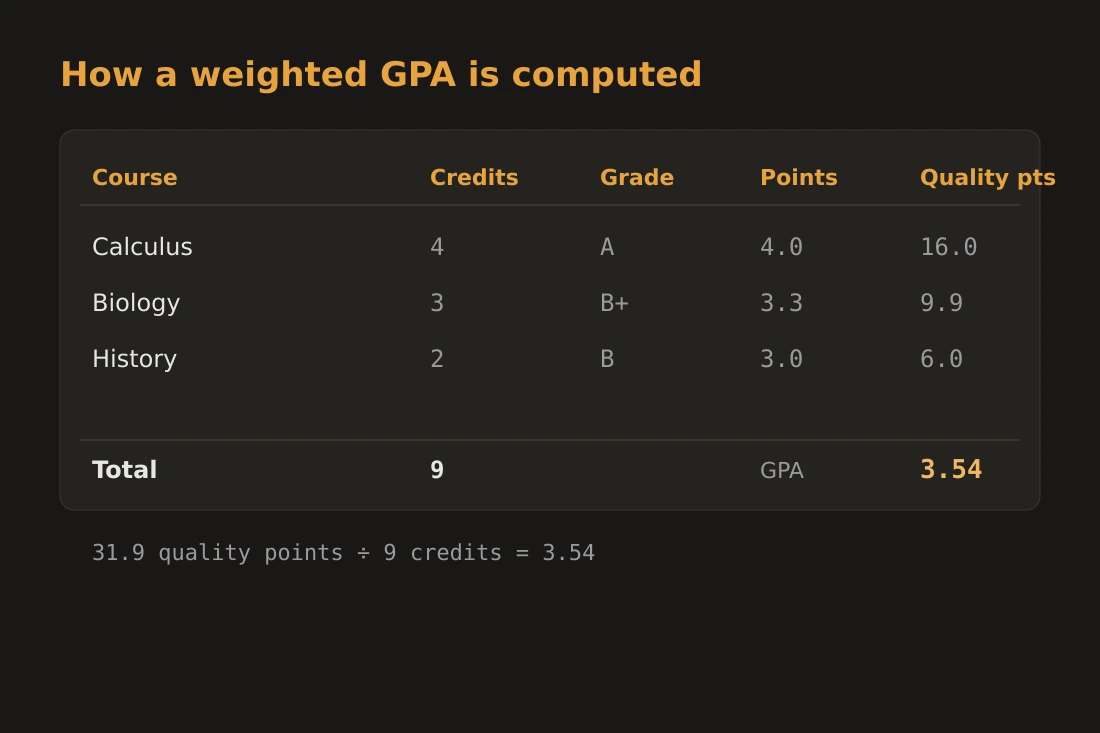
Grade Point Average is a weighted mean, not a simple average. For each course, you multiply the grade-point value of the grade you earned by the number of credit hours that course carries. Sum those products across all courses, then divide by the total number of credit hours attempted. The result is your GPA for that set of courses. A three-credit course where you earned a B (3.0) contributes 9.0 quality points. A four-credit course where you earned an A (4.0) contributes 16.0 quality points. Together, 25.0 quality points divided by 7 credit hours gives a GPA of approximately 3.57. Because credit hours are the weights, a four-credit lecture course pulls your GPA harder than a one-credit lab. This is why high-credit courses have an outsized effect on the final number, both when you perform well and when you do not.
Grade scales: 4.0 unweighted, weighted, plus/minus, and percentages
The 4.0 unweighted scale assigns whole numbers: A = 4.0, B = 3.0, C = 2.0, D = 1.0, F = 0.0. Many high schools and some colleges add plus/minus increments, so an A- is typically 3.7 and a B+ is 3.3, though the exact values differ by institution. Some schools use 3.67 for A- and 4.33 for A+; others cap the scale at 4.0 even for an A+. Weighted scales, used mainly in high school for honors and AP courses, raise the maximum to 5.0 or even 6.0, adding one or two points to the grade-point value of qualifying courses. College registrars almost always report an unweighted 4.0 scale, but some programs compute an in-major GPA on a different basis. Internationally, the percentage cutoffs for letter grades vary considerably: a 90 percent threshold for an A is common in North America, but other systems use 80 percent or higher. When entering grades into any calculator, verify the exact scale your institution publishes, because the math is only as accurate as the mapping you supply.
Term GPA vs cumulative GPA: momentum and inertia
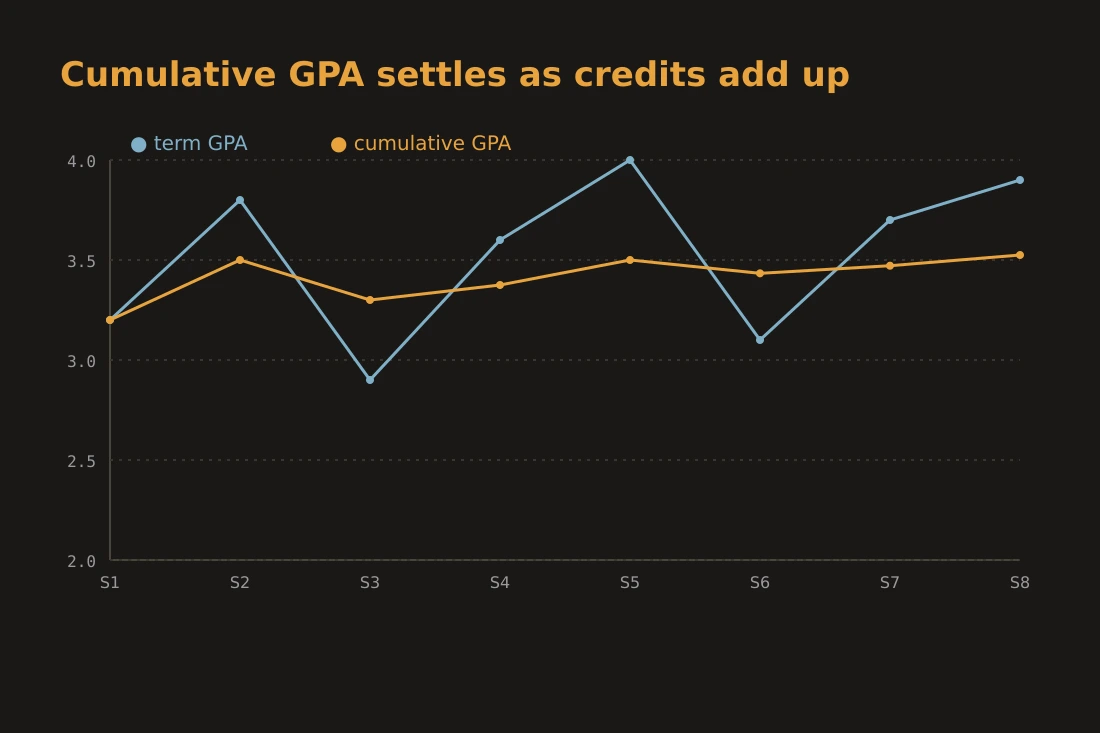
Term GPA covers only the courses in one semester or quarter. Cumulative GPA spans every credit hour you have attempted since enrollment. The relationship between them is straightforward but sometimes surprising in practice. Early in a degree, term and cumulative GPA track each other closely because the total credits are small. After two or three years of coursework, the cumulative total of attempted hours becomes large relative to a single term. A student carrying 90 credits who posts a 3.8 term GPA while sitting at a 3.2 cumulative GPA will move the cumulative figure by a much smaller margin than a first-semester student in the same situation. The same arithmetic works in reverse: a single poor term late in a degree cannot destroy a strong cumulative record because the weight of prior credits dilutes it. This inertia is neither good nor bad; it is simply a consequence of the weighted-average formula applied over time.
What-if planning: finding the grade you need
Before finals, many students want to know what grade they need in each remaining course to reach a specific cumulative target. The algebra is straightforward. Let C be your current cumulative quality points, H be your current cumulative credit hours, T be your target GPA, and N be the number of credit hours in the upcoming term. The minimum average grade-point value you need this term is: (T times (H + N) minus C) divided by N. If that number exceeds 4.0, the target is not reachable this term on a standard unweighted scale, no matter what grades you earn. If it falls below 0.0, you have already secured the target regardless of current-term results. Solving this equation for individual courses requires distributing the needed quality points across their respective credit-hour weights, which is more work but follows the same arithmetic. A calculator handles the iteration quickly once you supply the current totals and the target.
Using the gpa-calculator: your grades stay on your device
The gpa-calculator on this site runs entirely in your browser. You enter your courses, each with its credit hours and letter grade, and the calculation happens locally on your device as a single weighted average across the courses you enter. No data is sent to any server; nothing is stored outside your browser session unless you choose to save it. This matters for the practical reason that academic records are sensitive: transcript data, grade history, and enrollment status are all personal information. The tool uses a standard US 4.0 letter-grade scale built in (A+ and A both cap at 4.0, down to F at 0.0); if your institution uses a different scale, convert your grades to that table's equivalents before entering them.
Tools in this article
- GPA CalculatorCalculate your Grade Point Average instantly, weighted by credits, fully offline. Your data never leaves your device.
- Percentage calculatorWork out X% of Y, what percent X is of Y, percentage change, and increase/decrease by %. No upload.
- Grade CalculatorCalculate your weighted average grade and find out what score you need on your final exam.
Frequently asked questions
Does a pass/fail course affect my GPA?
It depends on your institution's policy. Most colleges exclude pass/fail credits from the GPA calculation entirely; they count toward degree requirements but contribute zero quality points and are not added to the credit-hour denominator. Some schools assign a grade-point value to a failing grade under pass/fail but not to a passing grade. Check your registrar's published policy, because including or excluding those credits changes your GPA calculation.
Can I raise my GPA by repeating a course?
Many institutions have a grade replacement or forgiveness policy that removes the original grade from the GPA calculation when you retake a course. Others keep both grades in the cumulative average. A few apply grade replacement only up to a certain number of repeated courses. The original grade typically still appears on your transcript even when it is excluded from the GPA. Verify your school's repeat policy before relying on a retake as a GPA strategy.
Why does my calculated GPA not match my official transcript?
The most common reasons are a different plus/minus mapping, excluded transfer credits, withdrawn courses counted as attempted hours by the registrar but not by your estimate, or a grade replacement policy you did not account for. Some schools also apply a separate calculation for in-major GPA that excludes electives. Compare your institution's official grade-point chart with the values you entered to find the discrepancy.